Do Adapters Ruin Sound Quality? How to Use 6.35mm, 3.5mm and 4.4mm Adapters the Right Way (with the KEYSION J2Jack01)
- Do adapters actually lose sound quality?
- 6.35mm to 3.5mm: when do you need it?
- Does a single-ended to 4.4mm adapter turn balanced?
- Will the mic still work after adapting a headset?
- How to pick an adapter or adapter cable
- When not to use an adapter
- Adapter or headphone: which affects the sound more?
- About the author
Swapping plug sizes, running studio-style headphones from a phone, or moving a headset with a mic to a different jack all call for an adapter. A well-made passive adapter barely changes the sound; it just fits one plug shape onto another. Whether it works, and whether the sound stays correct, comes down to plug type and pin wiring. The common cases split cleanly: size-to-size adapters are safe, forcing single-ended gear into a balanced jack is not, and any adapter for a mic headset starts with counting the plug's segments.
Do adapters actually lose sound quality?
A good adapter has a contact resistance below roughly 0.1Ω, which is negligible next to a 16Ω to 600Ω load. Dirty contacts and oxidation cause the hiss and the dead channel, not the act of adapting itself. Where sound really changes is a wrong adapter: pushing a single-ended plug into a balanced jack, or using one wired for the wrong pinout.
6.35mm to 3.5mm: when do you need it?
Desktop amps and audio interfaces mostly use 6.35mm jacks, while most IEMs ship with 3.5mm plugs, which is where the adapter earns its keep. The reverse case is just as common: to run a 6.35mm headphone from a phone or a dongle DAC you need a 3.5mm female to 6.35mm male cable. This kind of pure mechanical matching leaves channels and impedance alone. The only thing to check is whether the plug seats fully and the contact is firm.
Does a single-ended to 4.4mm adapter turn balanced?
No. Balanced output needs two separate amplifier channels and a separate ground. The adapter merely ties the left and right grounds of a 3.5mm plug onto 4.4mm, so the signal stays single-ended. To get true balanced drive you need a device with its own balanced jack.
| Adapter type | Feasible? | Result | What this means |
|---|---|---|---|
| 6.35mm and 3.5mm interconversion | Yes | Normal playback | Pure mechanical matching, no change in sound |
| Single-ended 3.5mm to 4.4mm balanced | Not advised | Still single-ended | You don't gain the higher voltage swing of balanced |
| Balanced 4.4mm to single-ended 3.5mm | Depends on device | May short | Some devices mute to protect themselves; don't force it |
| 3.5mm headset (TRRS) to stereo | Depends on pinout | Mic may stop working | Different pin wiring leaves the call with no sound |
| Adapter contact resistance | Usually under 0.1Ω | Negligible | Provided it's gold-plated and seated well |
Will the mic still work after adapting a headset?
It depends on the pinout. Phone headsets usually use TRRS 3.5mm (left, right, ground, mic - four segments), while many desktop devices only accept TRS (three segments). Put a TRRS plug into a TRS jack and the mic segment lands on nothing, so calls go silent. The other way around, a TRS headphone in a TRRS jack usually works fine, you just can't use the mic channel.
How to pick an adapter or adapter cable
Confirm the plug's segment count, the jack size and the direction first, then worry about materials. Gold plating and a stainless steel shell affect durability and contact, not tone.
- Count the plug's segments: three is TRS, four is TRRS (with a mic). Different segment counts do different jobs.
- Note whether the device is 3.5mm or 6.35mm, and whether the jack is single-ended or balanced. Never force a single-ended adapter into a balanced jack.
- Get the direction right: male to female or female to male. If you're unsure, use a cabled adapter and avoid one extra link.
- Once it's seated, listen to each channel on its own to confirm there's no dead side or background hiss. If you hear noise, clean the plug before blaming the adapter.
When not to use an adapter
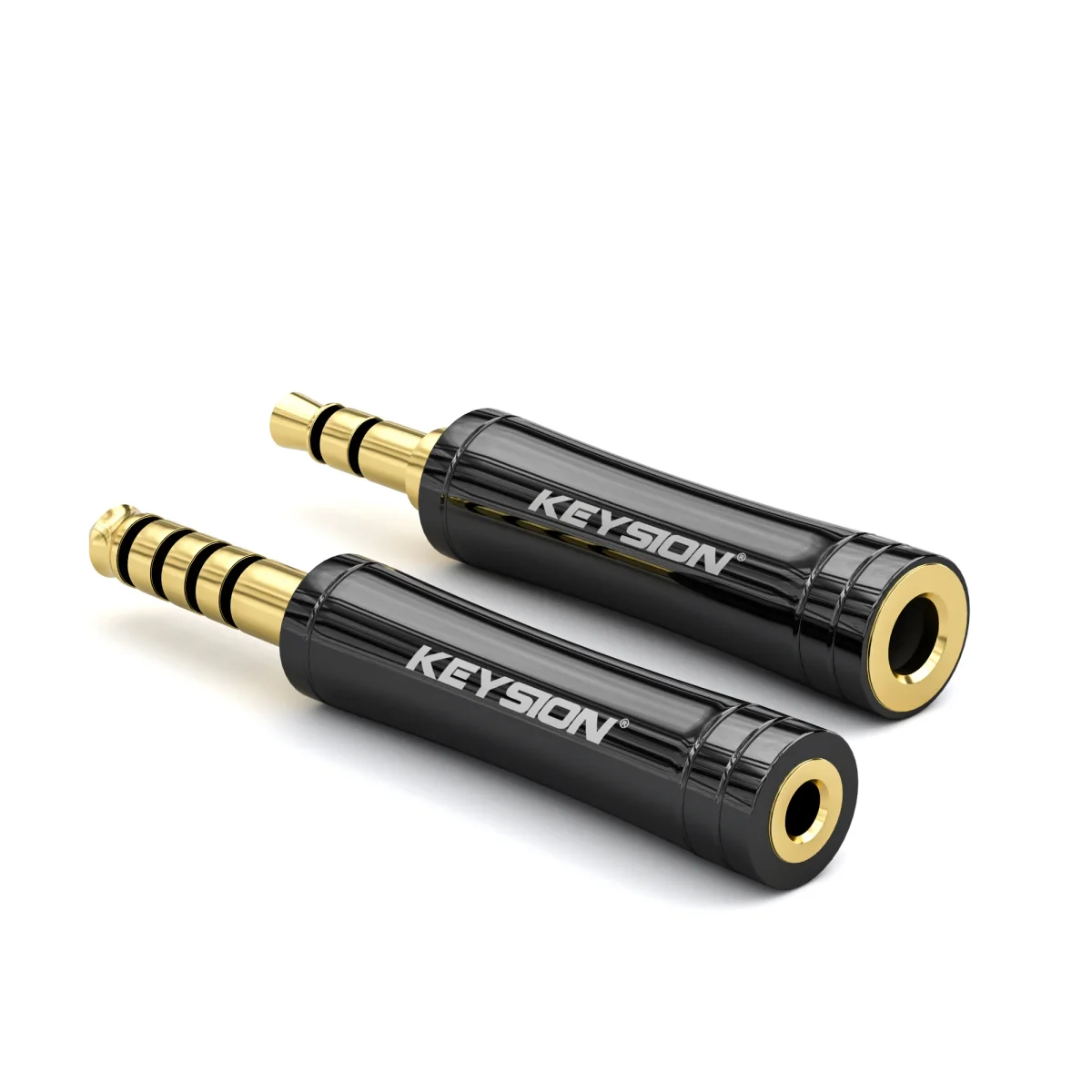
Don't force a single-ended adapter into a balanced jack. Very low-impedance IEMs paired with a cheap adapter can pick up contact noise. Before moving a headset with in-line controls across devices, check its pinout. The KEYSION J2Jack01 uses a painted stainless steel shell and gold-plated plugs, and it handles ordinary size matching. To run a 6.35mm headphone from a dual 3.5mm device, a dedicated 6.35mm to dual 3.5mm cable fits better.
Adapter or headphone: which affects the sound more?
An adapter can only match connectors; it can't change a driver or its tuning. The gap between 3.5mm single-ended and a 4.4mm balanced jack on the same headphone comes from the amplifier, not the adapter. Rather than obsessing over adapter materials, confirm the plug segment count and jack match first. Get those right and the sound usually falls into place.
Further reading: plug types and pinouts are covered in the 3.5/4.4/2.5mm plug guide; the difference between single-ended and balanced is in choosing between single-ended and balanced; how to tell real from fake balanced is in true vs fake balanced. Related products: the J2Jack01 adapter and the 6.35mm to dual 3.5mm cable.
About the author
Written by the KEYSION audio content team. We build DACs, upgrade cables and adapter accessories, and we check adapter contact resistance and pin wiring on the bench. The conclusions here rest on plug standards (TRS/TRRS) and common device jacks; for exact compatibility, check your own device's documentation.
FAQ
Do adapters lose sound quality?
A good passive adapter has very low resistance, so you won't hear a difference in normal use. Any noise usually comes from a loose or oxidized contact, not the adapter itself.
Can 3.5mm become balanced through a 4.4mm adapter?
No. Balanced needs separate amplifier channels and a separate ground. An adapter only does mechanical matching, so the signal stays single-ended.
The mic stops working when I plug my headset into a PC. What now?
First check whether the PC jack is TRS (three segments). A TRRS headset's mic segment lands on nothing in a TRS jack, so you need a TRRS-to-dual-TRS splitter.
How do I connect 6.35mm headphones to a phone?
Use a 3.5mm female to 6.35mm male cable, or pick a DAC/amp with a 6.35mm output. Keep in mind a phone may not drive high-impedance headphones well.
One channel goes silent with an adapter plugged in?
It's usually not seated fully or the contact is oxidized. Reinsert it firmly at a different angle, or wipe the gold-plated plug with pure alcohol.