Do Headphone Cable Length and Gauge Really Change the Sound? Resistance and Capacitance at 0.5m, 1.2m and 1.5m
Yes, it changes, but most listeners will not hear it. A 1.2m oxygen-free copper cable with 24 bundles of nine 0.05mm strands has about 0.10Ω of round-trip DC resistance; the same build at 0.5m measures near 0.04Ω. On a 3Ω IEM that is a 0.16dB level gap, and under 0.03dB on a 32Ω headphone. Where length really matters is thin wire, very long runs and high-current outputs, not 1.2m versus 1.5m.
How much DC resistance does one extra metre add?
Take copper resistivity at 1.7×10⁻⁸ Ω·m. A 0.424mm² conductor works out near 40mΩ per metre, and the signal travels out and back. A 1.2m cable sees about 96mΩ, 0.5m about 40mΩ, and 1.5m about 120mΩ.
Pins, solder joints and plug contact resistance are not in that figure. One 2-pin contact at 5-20mΩ is common, and four of them can match a short cable. Zero the multimeter with the probes shorted first, or half of the reading will be the probes.
| Cable build | Conductor area | Round-trip resistance (1.2m) | Loss on a 3Ω IEM | Loss on a 32Ω headphone | What this means |
|---|---|---|---|---|---|
| 24 bundles × 9 × 0.05mm, 1.2m | about 0.42mm² | about 0.10Ω | about 0.27dB | about 0.03dB | Normal length, level gap stays below audibility |
| Same, 0.5m | about 0.42mm² | about 0.04Ω | about 0.12dB | about 0.01dB | Lowest loss, plenty for desk use |
| Same, 1.5m | about 0.42mm² | about 0.12Ω | about 0.34dB | about 0.03dB | 0.07dB more, fine for standing use |
| 16 bundles × 14 × 0.06mm, 1.2m | about 0.63mm² | about 0.06Ω | about 0.17dB | about 0.02dB | Fewer bundles, thicker strands, larger area |
| Plain thin wire 0.08mm², 1.2m | about 0.08mm² | about 0.50Ω | about 1.3dB | about 0.13dB | Audibly congested on low-Z IEMs; replace it |
Which is thicker, 24 strands or 16?
Strand count describes construction; cross-section sets the electrical number. 24 bundles of nine 0.05mm strands make 216 filaments, about 0.42mm² in total. 16 bundles of fourteen 0.06mm strands make 224 filaments, about 0.63mm². The 16-bundle build has thicker strands and more of them, so its DC resistance runs roughly 30% lower.
LITZ winding rotates each filament along the length so current spreads more evenly. At 20kHz the skin depth in copper is about 0.46mm, so a 0.05mm strand sits fully inside the conducting layer. Skin effect barely matters in the audio band; LITZ mostly leaves headroom for high frequencies and long runs.
Does cable capacitance roll off the treble?
A 1.2m twisted pair typically shows 40-80pF of distributed capacitance. With 80pF into a 32Ω load, the RC corner lands above 60MHz, three orders of magnitude away from 20kHz.
Run 10m of line-level cable into a 10kΩ input and 1nF gives a corner near 16kHz, where the top octave starts to fall. That is a long interconnect problem, not a headphone cable problem. Headphone loads are low, so capacitance does almost nothing.
When can length actually be heard?
Three conditions have to line up. The IEM sits below 4Ω with sensitivity above 105dB/mW, the source has enough current that cable resistance takes a larger share, and the two cables differ by more than 0.1Ω. Miss one and the difference drops into measurement noise.
Match levels for any blind test. Keep the same source, the same IEM and the same pair of tips, calibrate both sides within 0.1dB, then listen at least ten times per cable. At a 0.3dB broadband difference most people are still guessing.
Microphonics interfere as well. A cable brushing a collar or a desk adds noise far above the resistance difference, so fix the cable in place before comparing.
Choosing between 0.5m, 1.2m and 1.5m
0.5m suits a dongle DAC on a phone at a desk, where the cable stays out of the way.
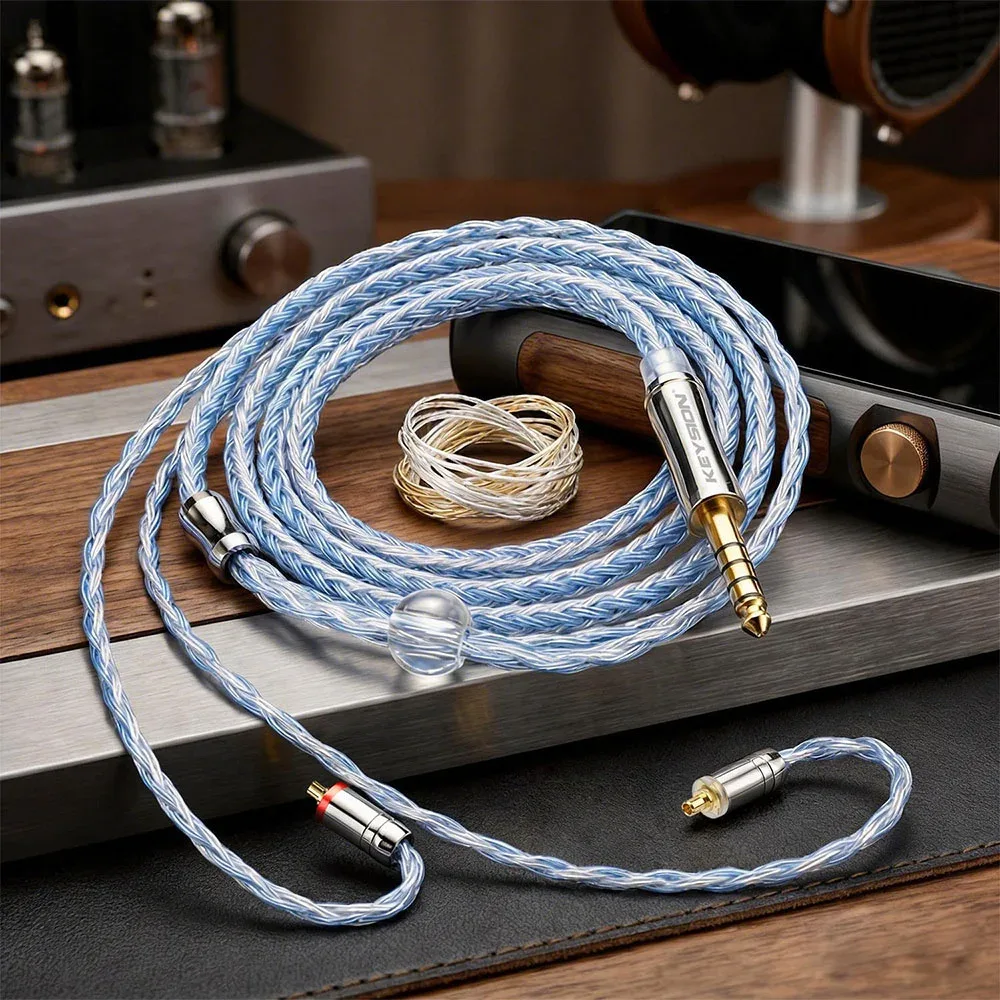
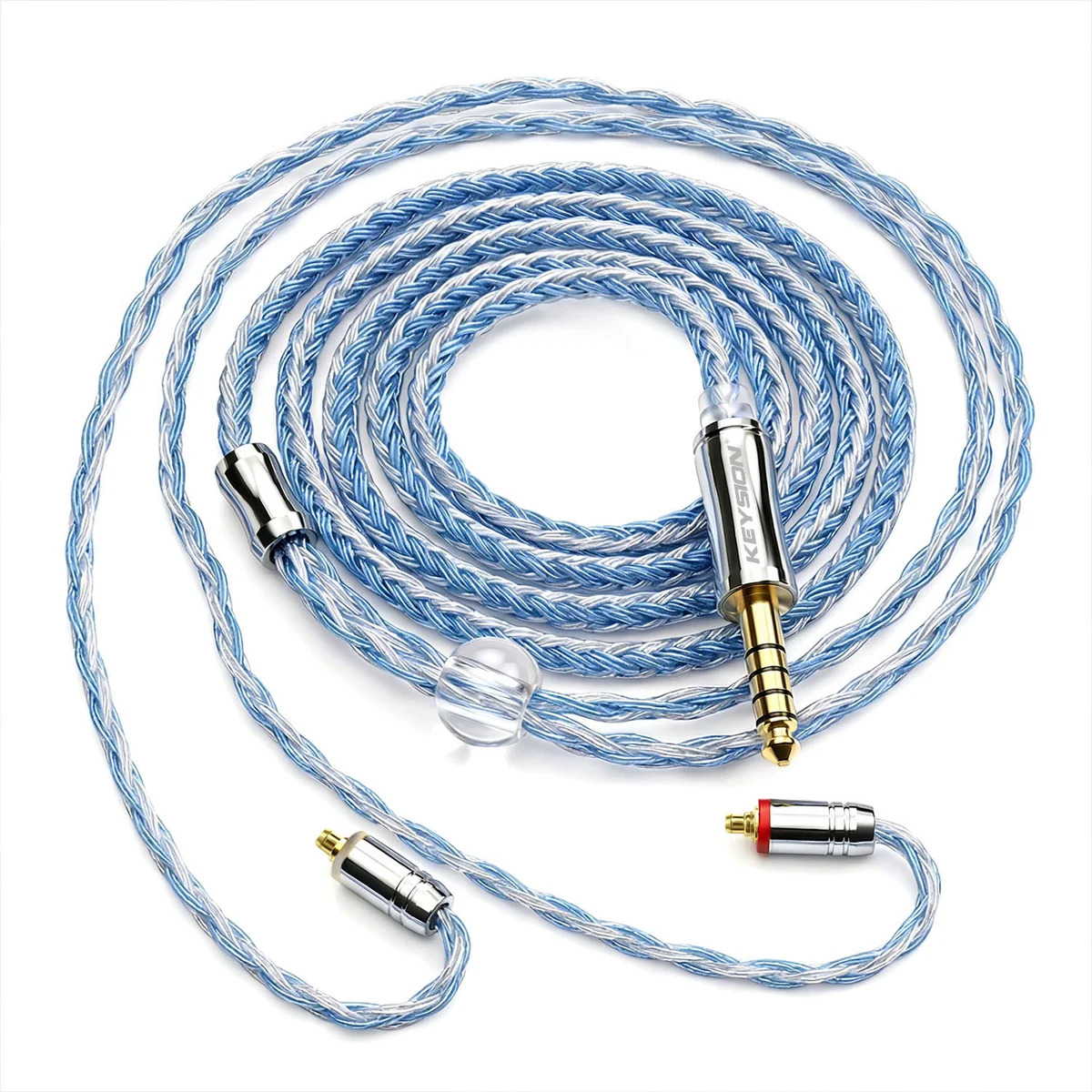
1.2m is the general-purpose length. Pocket, laptop and desk all work; the KSHF-24G and KSHF-16G ship at 1.20-1.25m.
1.5m covers a standing desk, a sofa or a speaker nearby. The extra 0.3m adds roughly 0.02Ω, which is electrically irrelevant, at the cost of snagging more often.
Build matters more than length. Straight plugs bend in a pocket, over-ear hooks cut microphonics, and plug type has to match: 3.5mm single-ended and 4.4mm balanced do not interchange.
Three common mistakes
A common claim: longer cable equals muddier sound. From 1.2m to 1.5m the resistance moves by 0.02Ω, inaudible unless IEM impedance is extremely low.
Another: judging sound by thickness. A thicker cable lowers resistance; it does not retune the IEM. At 3Ω the gap between 0.63mm² and 0.42mm² stays under 0.2dB.
A third: expecting a cable swap to fix everything. Loose contacts, cracked solder and oxidised pins can add ohms, so a new cable sounds very different because the connection finally works.
Measuring it yourself
A four-digit multimeter is enough. Short the probes, note the offset, measure the whole L+ to L- loop and subtract the offset. A 1.2m 24-strand cable should land near 0.1Ω; above 0.3Ω, check pins and solder.
A four-wire setup is more accurate because it removes probe and contact resistance. Without one, measure the same cable three times and look at repeatability.
Background reading: cable conduction and construction, copper purity and LITZ, upgrade cable buying notes and microphonics.
About the author: written by the KEYSION acoustics content team. We test cables and DACs with a multimeter and blind listening side by side. Resistance figures here assume pure copper; real products vary with pins, solder and length tolerance. Listening notes apply only to our test setup.
FAQ
Will sound change if I swap a 1.2m cable for a 1.5m one?
Most systems will not show it. Round-trip resistance rises by about 0.02Ω, under 0.1dB on a 3Ω IEM. Unless the IEM is below 2Ω or the source has very little current.
Does more strands mean better sound?
Strand count is construction; cross-section and purity set resistance. 24 × 9 × 0.05mm is about 0.42mm², 16 × 14 × 0.06mm is about 0.63mm², and the latter actually has 30% lower DC resistance. On normal loads the listening difference is small.
Does a 0.5m cable give better bass?
Lower resistance means slightly less loss, but usually under 0.2dB. What really shapes bass is tip seal and vent ports, not that 0.06Ω.
Can a multimeter measure headphone cable resistance accurately?
A 3.5-digit meter is only a rough screen. Zero the probes first and check pins when a reading passes 0.3Ω. For 10mΩ resolution, use a four-wire method or a current source.
Can cable capacitance make the treble dull?
Headphone cable capacitance is only tens of pF, so the corner sits in the megahertz range. Only a 10m line-level run into 10kΩ shows measurable treble roll-off.
Related products
Related articles