Do Diaphragm Materials Really Decide How Headphones Sound? Beryllium, Bio-Cellulose and Carbon Nanotube Compared, Judged on a KSHF-02 Pro Source
- 01 What does diaphragm material actually control?
- 02 Why is beryllium often called "metallic"?
- 03 Is bio-cellulose really warmer?
- 04 Are carbon nanotubes and graphene just marketing?
- 05 How do five common diaphragm materials compare?
- 06 Why do material swaps often fail a blind test?
- 07 Can a source or cable change the diaphragm?
- 08 Where should material rank when buying headphones?
Diaphragm material changes the ceiling and the tendency of a headphone's sound. It rarely decides the result by itself. What you hear comes from a balance of diaphragm thickness, geometry, stiffness and internal damping, then from crossover and enclosure tuning. Beryllium, bio-cellulose and carbon-nanotube composites move that balance in different directions, and none of them wins on every track. A source or cable does not rewrite the diaphragm's physics; it only sets whether you can hear the difference.
01 What does diaphragm material actually control?
A diaphragm is a film tens of microns thick that vibrates as a whole or in parts. Material affects three things. Stiffness sets the frequency where breakup starts, density sets how quickly the same driving force can move the film, and internal damping sets how much vibration energy gets absorbed inside the material.
These three pull against each other. High stiffness with low damping gives clean transients and often a treble peak. High damping with lower stiffness gives a smooth sound and a slower attack. Voicing is largely the job of finding a place between them.
02 Why is beryllium often called "metallic"?
Beryllium has a density of about 1.85 g/cm³ and a Young's modulus near 200 GPa. It is roughly half the weight of titanium and close to twice as stiff. At the same thickness, the diaphragm is stiffer and lighter, so breakup moves higher and transients start and stop cleanly.
Listeners often call it fast, detailed and bright. Part of that is the material. Part is tuning: lifting 3-8 kHz makes transients stand out, and some brands do it to show off stiffness.
In blind tests, if two same-size beryllium and titanium headphones differ by more than 2 dB in frequency response, most people hear the response first, not the material.
03 Is bio-cellulose really warmer?
Bio-fibre, paper and silk have high internal damping. Some vibration energy is absorbed inside the material, breakup peaks get flattened, and the top end stops sounding explosive.
The cost is efficiency and transient speed. High damping softens the attack, and drum edges lose some bite. People who listen to vocals, strings and slow music tend to accept that trade. Those who want electronic transients may call it soft or muddy.
The warmth is not a dye built into the material. It is mostly the relative effect of high-frequency loss. Drop 6 kHz by 2 dB on any headphone and it will feel warmer too.
04 Are carbon nanotubes and graphene just marketing?
Carbon nanotubes do have high specific stiffness. A composite diaphragm can stay stiff at a thinner gauge. The hard part is process control: dispersion, resin ratio and curing consistency all affect unit-to-unit matching.
In published measurements, composite and conventional diaphragms at the same price usually differ by about plus or minus 1-2 dB in response and a few dB in distortion. That is audible, but it is not the same scale as changing headphones.
Read the material name. Do not treat it as the only selling point.
05 How do five common diaphragm materials compare?
| Material | Density (g/cm³) | Stiffness (relative) | Internal damping (relative) | Common voicing | What this means |
|---|---|---|---|---|---|
| Beryllium | 1.85 | High | Low to medium | Fast transients, extended treble | High stiffness does not guarantee easy listening; enclosure and crossover matter more |
| Titanium | 4.51 | Medium-high | Medium | Solid, slightly bright | Heavier at the same size, more weight in bass, slightly slower transients |
| Aluminium | 2.70 | Medium | Medium | Neutral, slightly thin | Low cost and enough stiffness, but breakup arrives earlier |
| Bio-cellulose / paper | — | Low to medium | High | Warm, smooth | Damping buys smoothness and costs some attack |
| Carbon-nanotube / graphene composite | — | High | Medium to high | Light, detailed | Process consistency matters more than the material name |
The modulus and density above are bulk-material figures. A diaphragm is tens of microns thick and carries coatings and adhesive layers, so these numbers do not directly predict frequency response.
06 Why do material swaps often fail a blind test?
Three reasons. The levels are not matched, so the louder one wins. The tracks are wrong, because vocals and slow songs barely expose transient differences. The sample is too small, and guessing 6 out of 10 is normal.
We covered level matching in a separate article: match the two devices to within 0.1-0.2 dB, then run 10-16 ABX trials. Without that step, a material comparison turns into "which tuning do I prefer".
The full procedure is in how to run a level-matched AB blind test.
07 Can a source or cable change the diaphragm?
No. The diaphragm is a mechanical part. Voltage swing from a DAC or amp does not change its material properties. A source changes distortion, noise floor, output impedance and usable volume. Those decide whether you can hear clearly, not what character the diaphragm has.
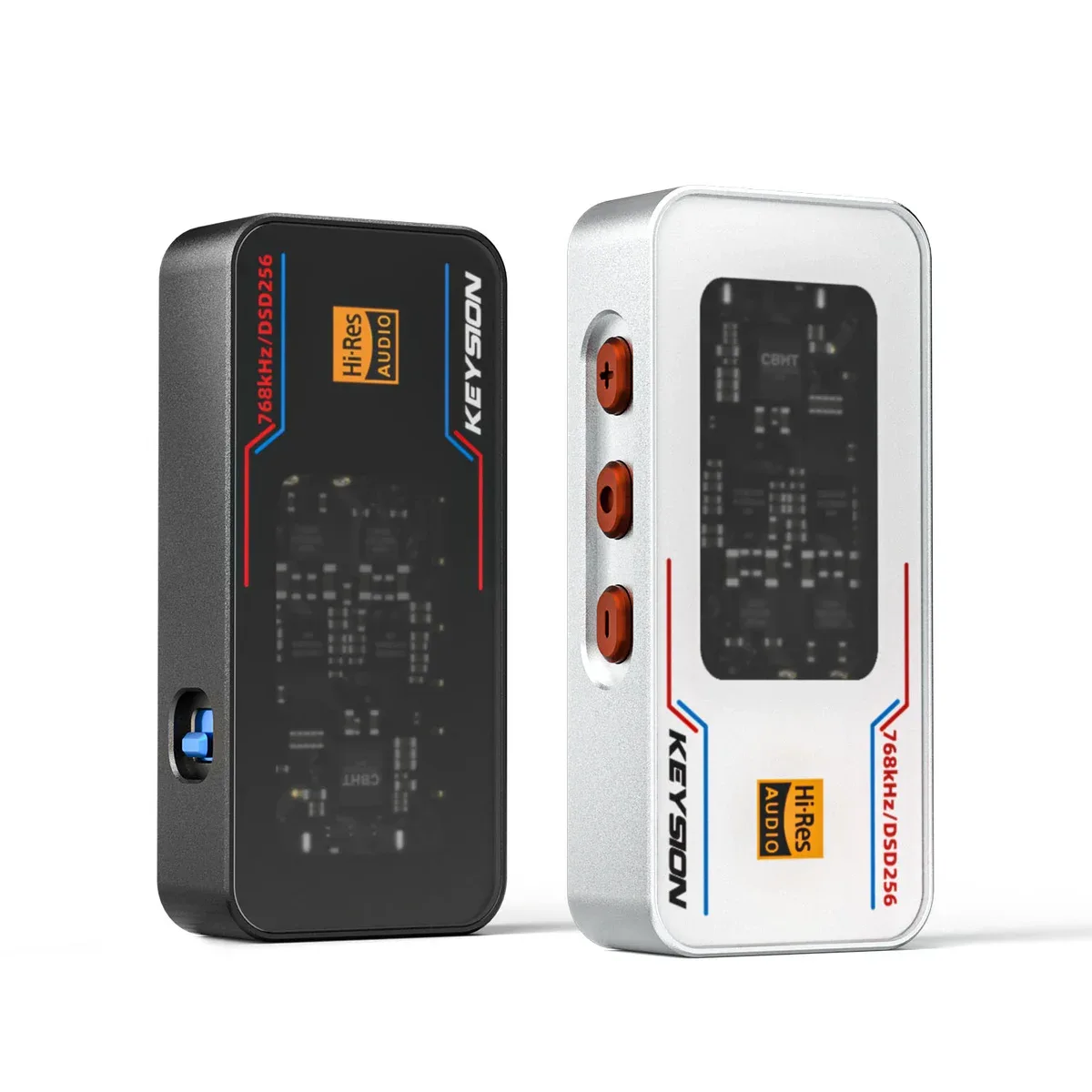
A source such as the KSHF-02 Pro, with 551 mW of output, leaves more headroom for high-impedance headphones. You do not need to run the volume near the top, and high gain does not magnify its noise floor. It will not make a bio-cellulose diaphragm brighter, but it lets you judge that diaphragm at a sensible level.
Cables matter even less. The 24-strand blue-silver cable and the 16-strand green-silver cable change a few ohms of DC resistance and a little capacitance. That is close to inaudible on high-impedance headphones and only marginal on low-impedance, high-sensitivity IEMs.
08 Where should material rank when buying headphones?
After frequency response, distortion, fit and unit consistency. Material sets the ceiling and the tendency; tuning decides what you actually hear. The same driver can change more through a different nozzle, ear tip or crossover than through a different diaphragm material.
For related measurement thinking, read how ear tip material changes sound and ear pad material and fit. For driver basics, see which of the four driver types to choose.
About the author: KEYSION Acoustic Editorial Team. We build portable DACs, cables and accessories, not headphone drivers. The figures here come from public material data and common measurement practice, and the listening descriptions are deliberately hedged. Without level matching and blind trials on your own system, any material conclusion is only a reference, not a substitute for listening.
Measurement basis: Frequency response and distortion measurements follow IEC 60268-7 where applicable.
FAQ
Is a beryllium diaphragm always better than a standard dynamic driver?
No. Beryllium mainly raises stiffness and pushes breakup higher, which suits tunings that chase transients and treble extension. If the enclosure and crossover are not sorted, that stiffness can exaggerate a treble peak and sound harsher. In blind tests, frequency response usually outweighs the material.
Does bio-cellulose degrade in humid conditions?
Paper and bio-fibre are sensitive to moisture and can warp or develop mould in long-term high humidity. Normal indoor use is usually fine; do not soak them or store them in a bathroom. Composite versions carry moisture-resistant coatings, but those coatings also age.
Are carbon-nanotube diaphragms a gimmick?
Not entirely. Nanotube composites can hold stiffness at lower thickness, and the real challenge is process consistency. Published measurements usually show differences of about plus or minus 1-2 dB in response and a few dB in distortion at the same price, which is audible but not the scale of changing headphones.
Can an upgrade cable reveal diaphragm differences?
Rarely. A cable changes a few ohms of resistance and a little capacitance. On high-impedance headphones that is close to inaudible; on low-impedance, high-sensitivity IEMs the effect is marginal and has nothing to do with the diaphragm.
Is it reliable to buy headphones by diaphragm material alone?
Not enough. Check frequency response, distortion, fit and unit consistency first. Material describes the design ceiling; tuning describes what you hear. Use material as a filter, not the only criterion.
Related products
Related articles