Do Eartip Materials Change the Sound? Silicone, Foam, and Hybrid Tips Compared (KEYSION 30A Test)
Eartip material does change the sound, but the changes are more localized than most people expect: it mainly affects bass energy below 1kHz and treble quantity above 8kHz, while the midrange position barely moves. This article is for anyone who finds the bass thin, the treble too sharp, or commute noise hard to block out with in-ear headphones. Here is the conclusion up front: if you want stable bass, get the seal right first and treat material as a distant second; the brightness or darkness of the treble is where material really makes a difference.
Material determines the seal first, then the treble. Silicone tips rebound quickly and have a smooth surface, holding in place through friction against the ear canal wall, so how well they seal depends heavily on canal shape; memory foam tips rebound slowly after being squeezed and can fill an irregular canal, giving a steadier seal. Once the seal changes, the bass follows, and this is the part listeners notice most easily.
| Comparison | Silicone tips | Memory foam tips (e.g. KEYSION 30A) | What it means |
|---|---|---|---|
| Passive isolation | about 15-25 dB | about 25-35 dB | Foam blocks more ambient noise; the difference shows up more on the subway or in an office than in a quiet room |
| Bass (<1kHz) | prone to leaking energy when the seal is unstable | rebounds to fill the canal, steadier bass | If the bass feels thin, suspect the seal first, not the driver |
| Treble (>8kHz) | keeps more air | usually rolls off 2-6 dB | Foam sounds softer, silicone brighter; it depends on the earphone's own tuning |
| Cleaning and lifespan | washable, about 6-12 months | consumable, about 1-2 months | Foam tips need regular replacement; once rebound fails, the seal gets noticeably worse |
The isolation figures in the table come from third-party labs and manufacturers' public materials. The order of magnitude is reliable, but your own ear canal will shift the numbers, so do not treat any single dB figure as a hard spec.
Yes. The wider the bore, the shorter and wider the path from the sound outlet to the eardrum, so the treble usually sounds brighter and more open; a narrow-bore tip compresses the treble and sounds more restrained. This is why the same earphone with different tips can feel more transparent to one listener and muddier to another. Hybrid tips (silicone inside, foam outside) try to cover both ends: the silicone holds the bore shape while the foam provides the outer seal.
The criterion is not price but symptoms. If the bass clearly fluctuates when you turn your head or talk, or you have to keep raising the volume to mask noise, the seal is insufficient and a change is worthwhile. If the fit is comfortable and the bass is steady and you just want a bit more treble, the payoff from swapping tips is limited — in that case adjusting EQ (/blog/headphone-eq-guide) may be more direct. Do not treat tips as an upgrade part; they are closer to a fitting.
A poor fit is not necessarily the material's fault. Check in order: whether the size is right (go one size up if it leaks easily, one size down if it hurts); whether the nozzle angle lines up with the ear canal; whether the old tips have aged and deformed. Sort out these three before discussing material, or a swap may leave things exactly as they were. Rushing to buy expensive tips the moment bass goes wrong is like taking medicine before diagnosing the cause.
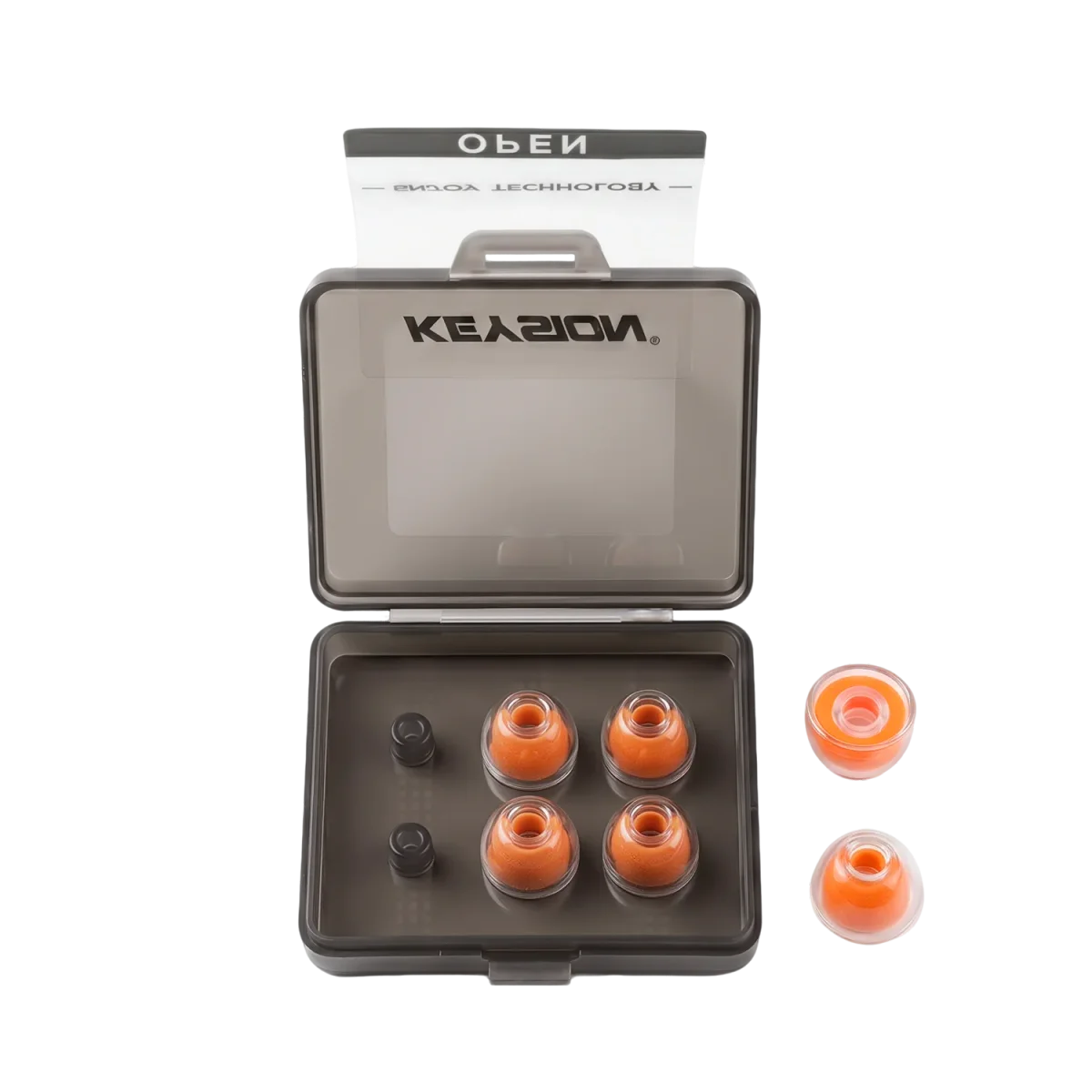
Who suits them: people whose ears ache with silicone tips, who face loud commuting noise, or whose ear canal is irregular and silicone always leaks. Who does not: those who prefer bright treble, who do not want to replace consumables often, or who already get a good fit. KEYSION 30A (/product/ersai-haimian) uses a liquid silicone memory foam construction, and its sizes and specs are on the product page. To understand sealing more systematically, start with the fit and seal article (/blog/iem-fit-seal-sound-guide); if your earphone is a multi-driver design, crossover and driver layout (/blog/multi-driver-iem-crossover-guide) also shape what you hear after a swap.
If you have confirmed the problem is not the seal but the contact or the source chain, then look at accessories such as the KEYSION S35 upgrade cable (/product/kshf-s35) or the 24G upgrade cable (/product/kshf-24g) — though the audible change from a cable is usually smaller than getting the seal right.
About the author: Compiled by the KEYSION Audio Lab. Isolation and frequency response figures reference third-party labs and manufacturers' public materials and are order-of-magnitude references; listening impressions vary between individuals, and what matters is how they actually fit you.
FAQ
Can changing tips really give you more bass?
Yes, but only if the original tips did not seal well. The bass change from a swap comes mainly from better sealing, not from the tips adding bass; if the fit was already tight, the bass change will be small.
Do memory foam tips make the treble sound dull?
Usually yes, on the order of a 2-6 dB roll-off. People who prefer bright treble may not like it; that part can be brought back with EQ while keeping the foam isolation advantage.
Are hybrid tips better than pure silicone or pure foam?
Not necessarily. Hybrids try to balance a stable seal with bore support, and the result depends on ear canal shape and the earphone. Do not assume they are better; what counts is whether the bass stays steady once you wear them.
How often should tips be replaced?
Foam tips last about 1-2 months; replace them once rebound slows noticeably or the surface cracks. Silicone tips are washable and last about 6-12 months, but replace them too when they harden, deform, or crack.
Changing tips or changing an upgrade cable — which is more worthwhile?
Get the tips right first. The change from sealing is usually larger than from a cable; only when seal, source chain, and source are all fine does the faint difference of a cable deserve attention.
Related products
Related articles