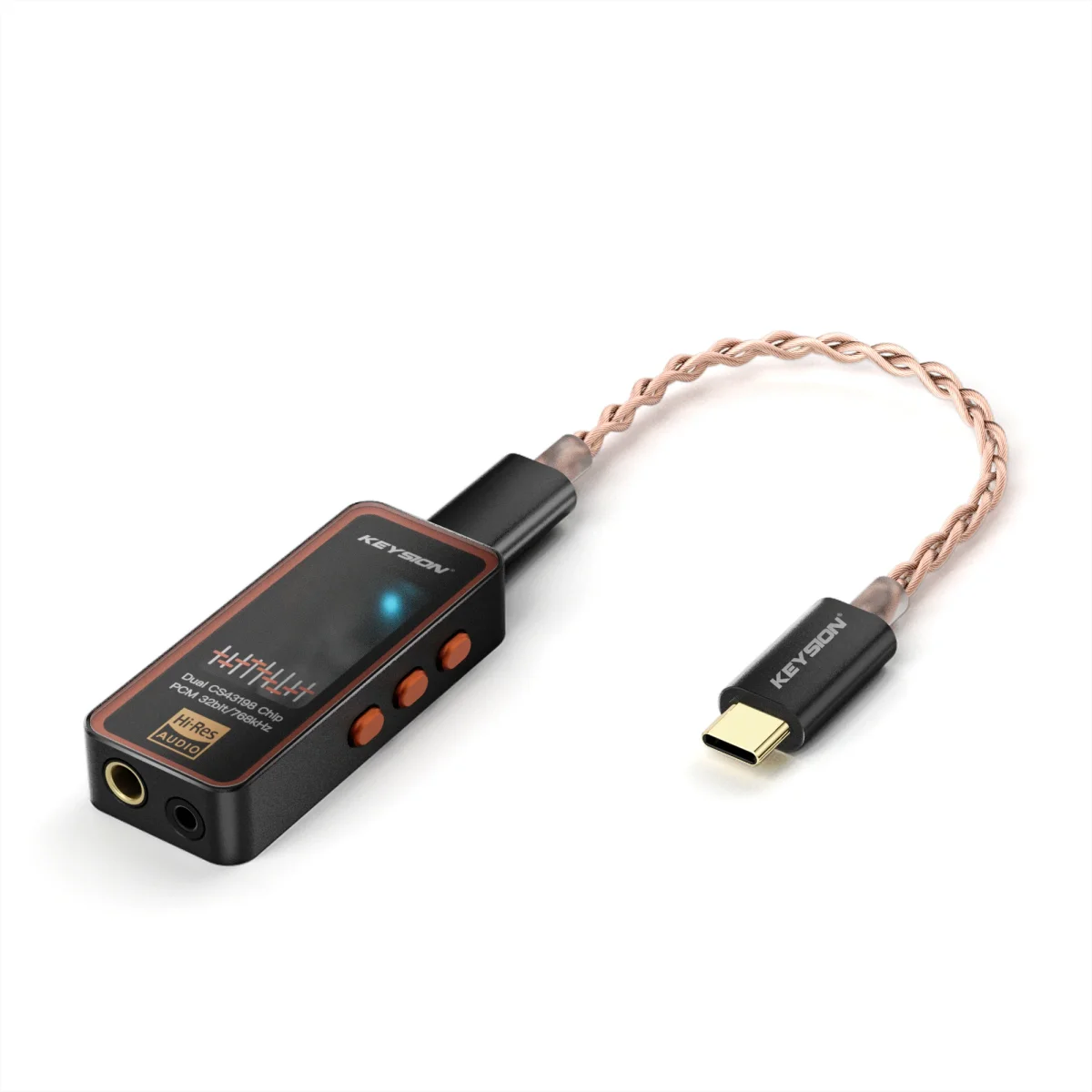
How to Read a Headphone Frequency Response: Target Curves, Tuning Taste, and What the KEYSION 02 Pro Actually Measures
- What the horizontal and vertical axes of a frequency response actually mean
- Does a flat curve mean it sounds good
- What the Harman target and DF curves are, and how they differ
- Why the measured curve changes when you switch ear tips
- The frequency response of a DAC/amp and of a headphone are two different things
- How not to get led astray by a shop's "curve marketing"
- About the author
Frequency response is a headphone's health report: the horizontal axis is frequency, the vertical axis is loudness, and one line tells you whether the bass is heavy and whether the treble stings. This article shows you how to read that line, and why a flat curve does not equal good sound — tuning is ultimately a matter of taste, not right and wrong. I'll use the KEYSION 02 Pro and 30A ear tips as examples and translate the Harman target curve, the DF curve, and the "V-shaped tuning" banner shops like to put on product pages into plain language.
When in doubt, start with the quick-reference table below, then read the details.
| Axis | What it represents | What this means |
|---|---|---|
| Horizontal (Hz) | Pitch of a sound | Left is bass, right is treble; a human ear perceives roughly 20Hz to 20000Hz |
| Vertical (dB) | Relative loudness of a frequency band | The higher the curve, the louder that band; the closer the line is to flat, the closer the sound is to "neutral" |
| Reference line / 0dB | The calibration baseline | Compare it against the shop's curve to see which bands were deliberately boosted or cut |
The horizontal axis is frequency in Hz, marked from 20 up to 20000, covering the range of human hearing. Bass drums sit at 50–200Hz, the core of vocals lands in 300–3000Hz, and sibilance and cymbal harmonics appear around 6–10kHz. The vertical axis is in dB, a relative value — a 10dB difference sounds roughly like twice the loudness.
There's a handy trick to reading this line: first look at the "overall shape" of the curve, then at sudden jumps in a particular band. A curve that rises overall tends to sound warm and thick; if the mids dip, vocals recede as if behind a veil. Don't obsess over 1–2dB wiggles — with an ordinary phone and stock tips, most people can't actually hear that fine a difference.
No. This is a common misunderstanding: "flat" on a graph is measurement-neutral, but the human ear itself is not neutral. The Fletcher–Munson loudness curve shows the ear is naturally more sensitive to the mids than to the bass and treble, especially at lower volumes.
So a theoretical straight line often doesn't sound "balanced" at all — it comes across as flat and short on atmosphere. That's why so many headphones deliberately boost the bass a little and roll off the treble a touch rather than going perfectly flat. Manufacturers aim to satisfy most people's hearing preferences, not to please an oscilloscope.
The Harman target curve is a "what most people like" shape statistically derived from large-scale blind listening tests at the Harman lab. It lifts the bass region noticeably and rolls off the treble slightly, sounding familiar and full of atmosphere. The DF (diffuse-field) curve simulates how a speaker sounds in a real room, with more prominent, more neutral mids; it can feel "plainer" on classical and vocals.
| Target curve | Bass tendency | Where it shines | What this means |
|---|---|---|---|
| Harman | Noticeably boosted | Pop, electronic, gaming | Bass is more atmospheric, but some find it too much and boomy |
| DF (diffuse-field) | Near-flat | Classical, instrumental, speech | Mids are cleaner and more direct, but can feel "cold" at first |
Both curves are references, not answers. Whether you find a headphone's bass too heavy is largely a matter of personal taste and environment — the numbers on the curve can't make that call for you.
For IEMs, the curve isn't welded to the headphone. How you seat it in your ear, the tip size, even the tip material all change the actual bass and mid-bass response. A good seal lets the bass develop; an air leak makes it collapse, and the whole sound turns thin and dry.
This is a good moment to bring up the KEYSION 30A memory-foam ear tips: the foam slowly expands with your body heat and fills the ear canal more firmly than ordinary silicone, giving a more stable seal and a bass response closer to the headphone's stated curve. If a pair of IEMs sounds like it has intermittent bass, switching to a better-fitting tip is usually cheaper than changing headphones, and a fairer conclusion than "these IEMs are bad."
To be honest, the electrical frequency response of a portable DAC/amp like the KEYSION 02 Pro is already nearly flat — distortion and jitter are both low, and what it does to the signal is basically "amplify as-is," so it shouldn't flavor the curve. The sound you actually hear is mostly set by the headphone you plug in and how it fits your ear.
So reading the frequency response of this kind of product isn't very useful; what matters is whether it has enough power to drive your headphone and its noise floor. That's a totally different mindset from picking ear tips by their curve. I've gone into how to calculate power here: how much power your headphone actually needs.
Shops love to throw around terms like "V-shaped tuning" and "Harman-style tuning." In plain language: a V shape usually means boosted bass and treble with a slightly dipped midrange — fun for pop, but vocals sit further back. "Harman-style" claims generally chase the Harman curve, but whether the actual measurement really hugs it is open to question.
Three practical tips: first, look at the overall shape, not the fine wiggles; second, if the midrange dips by more than a few dB, vocals will recede noticeably, which is more worth worrying about than a bright treble point; third, when you can, A/B with music you know well — what your ears pick up is what counts. The curve is a reference; whether the sound truly pleases you is decided by your eardrum.
This article is written by the KEYSION acoustic lab, which routinely measures parameters and listening impressions across products like the 02 Pro, 02, and 30A. We try to keep parameters as parameters and listening as listening, hand you the tools for judgment, and leave the "should you buy it" choice to you. To understand how sample rate affects how things sound, see the truth about sample rates; to tell driver types apart, see how to choose among four driver types.
Give the KEYSION 02 Pro a try, or pair it with a well-fitting set of tips, and run this curve-reading method on songs you know well — it beats memorizing a pile of numbers.
FAQ
Is a flatter frequency response always better?
Not necessarily. Flat is neutral in terms of measurement, but the human ear itself is more sensitive to the mids, so a perfectly flat headphone often sounds plain. Whether it sounds good depends more on personal taste; flatness of the curve is just one reference dimension.
What is the Harman target curve, and is it right for everyone?
The Harman target curve is a popular tuning shape derived from a large number of blind listening tests, with boosted bass and a slightly rolled-off treble. It is a statistical reference, not something everyone must like — some people find the bass too much, so judge by your own ears.
Does changing ear tips really change the frequency response?
Yes. An IEM's bass response depends on the seal; the better the fit, the more stable the bass. The KEYSION 30A memory-foam ear tips improve bass response with a tighter seal, so if your IEM's bass comes and goes, switching tips is usually cheaper than switching IEMs.
Is there a simple way to read a headphone's frequency response?
First look at the overall shape of the curve, then check whether the mids dip noticeably. Roughly: find the reference baseline, read the bass/mid/treble sections left to right, compare against Harman or DF to spot deviations, and finally A/B with songs you know well to confirm.
Related products
Related articles