Does a Bad Eartip Fit Kill the Bass? How Seal and Fit Shape IEM Sound (Tested with KEYSION 30A Foam Tips)
If you feel your in-ears sound thin on bass, hollow in the middle, or never stay put, this is for you. The short version: on the same IEM, swapping eartips and adjusting how they sit can change what you hear more than buying a costlier cable. Once the low end leaks—roughly below 1 kHz—the energy drops noticeably and it sounds like the bass vanished; seal it properly and the low end feels firmer and fuller. To put it plainly, when an IEM sounds off, suspect the tips and the fit before you blame the earphone itself.
A lot of an in-ear's low end relies on a sealed air cavity inside the ear canal. When the tip does not close off the canal, the bass (below about 1 kHz) escapes through the gap and isolation drops with it, so the low end gets thin and the midrange sounds hollow. Skip the theory, look at the measurement: with a loose seal the low-frequency response slides downward, which is why many listeners describe a leaking IEM as having its bass hollowed out.
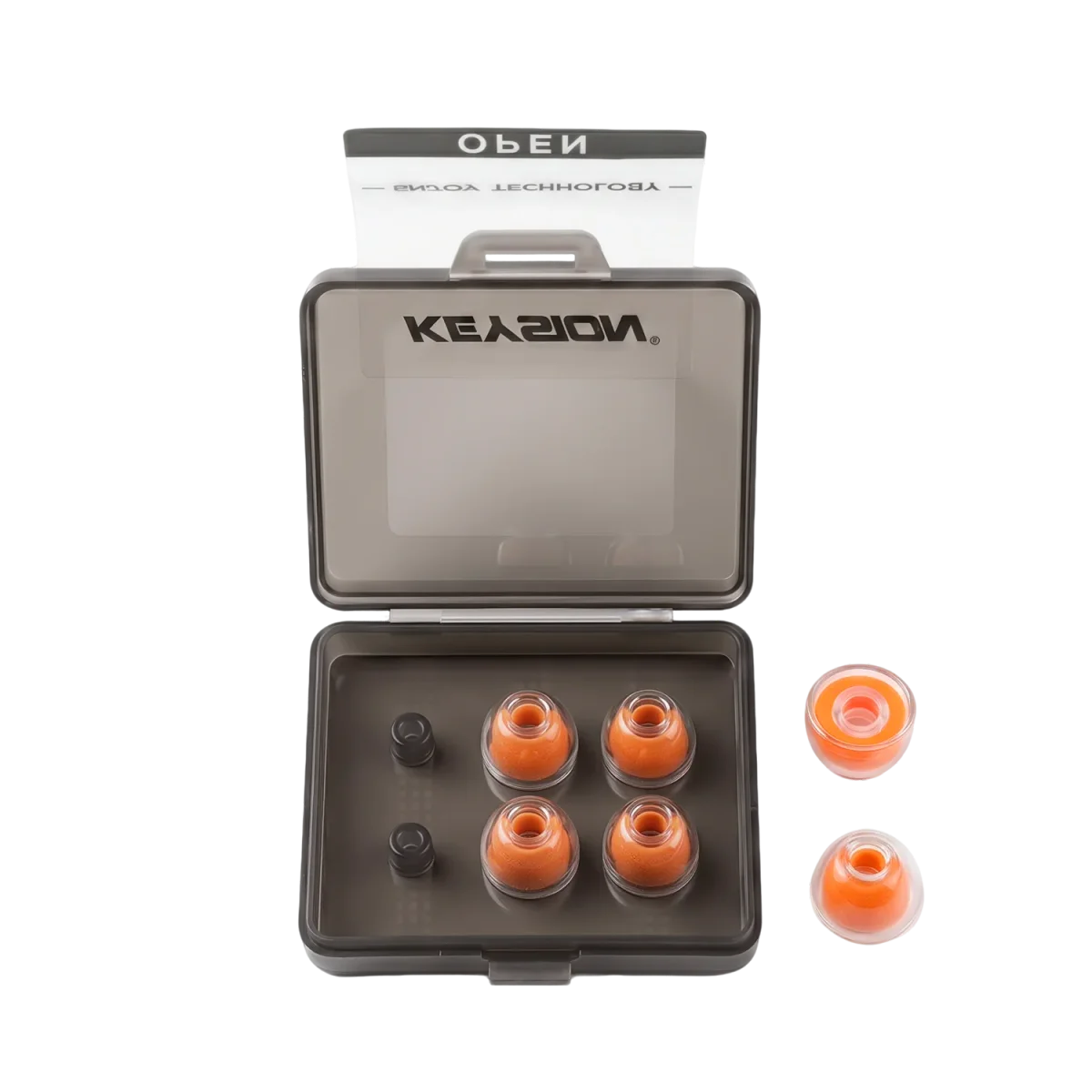
The tip material decides how stable the seal is and how it changes the treble. Silicone tips are durable and easy to clean, but a single-flange silicone tip only seals as well as your ear shape allows, and it can drop the seal when you nod or talk. Memory foam tips are squeezed, inserted, then slowly expand to fill the canal, which gives a steadier seal and usually better isolation.
| Property | Silicone (common) | Memory foam (e.g. KEYSION 30A) | What this means |
|---|---|---|---|
| Passive isolation | about 15-25 dB | about 25-35 dB | Foam blocks more background noise, clearer on the subway or at the office |
| Seal stability | follows ear shape, affected by movement | expands after insertion, steadier | Lower chance of leaks; bass does not suddenly drop out |
| Treble (above about 8 kHz) | keeps more air | typically damped 3-6 dB | Foam sounds a bit darker, silicone brighter; a taste call |
| Cleaning and life | easy to wash, long-lasting | loses spring over time, replace it | Foam is consumable, do not expect one set to last a year |
What this means: for a solid, stable low end, get the seal right first; whether the treble feels airy or dark largely comes down to taste and the earphone's own tuning, not a guarantee that foam is better.
Too small a tip, or a bore that does not aim into the canal, wastes even an expensive tip. The test is simple: after fitting, shake your head lightly and talk—the bass should not wobble noticeably; press the shell gently and if the bass shifts a lot, the seal is still loose. For most people the right size does not need a hard push to the bottom, just a fit that is snug and steady.
A poor fit is not always the tip's fault. Check in order: whether the tip size fits; whether the bore angle and the shell aim into the canal; and whether the tip has aged or deformed. Sort these out before you swap, or a new tip can fail the same way. Chasing a pricey tip while the bass is off is treating the symptom before finding the cause.
If silicone always irritates your ears, or commuter noise keeps pushing your volume up, memory foam is a reasonable investment. The other way around—if your fit is fine and you do not mind a brighter silicone—there is little reason to upgrade just to upgrade. You can check the specs of the KEYSION 30A memory foam tips (/product/ersai-haimian), and a more detailed buying guide (/blog/memory-foam-ear-tips-30a) to compare.
One line to end on: if the bass is unstable, the problem is usually the fit and the tips, not the IEM itself. Getting the fit, size and material right usually pays off more than buying pricier gear. A more relevant upgrade direction is the KEYSION 16G cable (/product/kshf-16g), which addresses a small effect on tone—but you want the seal solved first before those differences mean anything.
About the author: Compiled by the KEYSION audio lab from industry-standard public measurements and community blind-test consensus, for reference only and not an absolute verdict. On your own ears, the only test that counts is wearing them.
FAQ
Why does the bass actually get weaker after I switch to pricier tips?
A change in low end after swapping tips usually comes down to the seal, not the price. Foam tips tend to sound darker and damp the treble, while silicone is brighter but seals less steadily. Judge by whether the bass is stable and solid, not by the price tag.
Can memory foam tips hurt my ears?
Foam tips at the right size, worn properly, do not. The real downside is that they are a consumable: replace them once the spring is gone. If a visibly oversized tip causes soreness, size down instead of forcing it in.
How do I know whether my IEM is seated correctly?
If the low end wavers noticeably when you nod or talk, or shifts a lot when you gently press the shell, the seal is loose. When it fits snug and steady and the bass does not wobble with movement, you are basically there.
Are silicone tips always worse than memory foam?
No. Silicone keeps more treble air and is easier to clean, good for people who like a brighter sound and have tolerant ears; memory foam seals and isolates more, giving a steadier low end, but sounds darker. Which to pick is a matter of taste and environment.
What is the most reliable way to choose tip size?
There is no universal size chart. The test is fit and stability: the bass should not waver with head turns or talking. Start from a smaller size and do not force an oversized tip just for a seal, since that usually ends in soreness and leaks anyway.
Related products
Related articles