What Do the Vents on an IEM Actually Do? Does Plugging Them Add Bass, and What 30A Memory Foam Tips Change

- 01 What is the vent relieving?
- 02 Does sealing a vent add bass?
- 03 Front vent versus rear vent
- 04 Isolation and venting are separate, and should not be lumped together
- 05 For more bass, start with the tip
- 06 What can go wrong when you seal a vent?
- 07 When to change a cable, and when to leave the vent alone
- About the author
The small holes on an in-ear shell are not decoration. They equalise the air pressure on both sides of the diaphragm. A rear-chamber vent shapes how much bass you get and how quickly it decays; a vent near the nozzle releases positive pressure that builds up inside the ear canal. Plug the holes and bass rarely increases in any predictable way. What usually happens is a tighter, muddier low end, rising distortion, and a driver that clicks as pressure pushes on it. If you want more bass, a better-sealing tip is the reliable lever.
01 What is the vent relieving?
A dynamic driver sits between two air volumes. Push the diaphragm forward and the rear chamber compresses; pull it back and the chamber rarifies. Seal that chamber completely and the trapped air turns into a spring that fights the diaphragm and shortens its stroke.
A vent plus a mesh or foam disc forms an acoustic resistance. Hole area, channel length and damping material together set the compliance of the rear volume and the low-frequency roll-off. A larger vent usually gives a cleaner, quicker low end; a smaller one stiffens the air spring and can lift a narrow bass band.
The vent near the nozzle solves a different problem. Once a tip seals the canal, swallowing, walking and temperature changes unbalance pressure on both sides. The small hole bleeds off the excess so the diaphragm is not loaded and does not flex with an audible click.
| Vent | Typical location | Main job | Measurable change if sealed | What that means |
|---|---|---|---|---|
| Rear chamber vent | Back or side of shell | Relieves rear pressure and shapes bass | Driver Fs rises 5-15 Hz, sub-bass shallowens, distortion climbs above 90 dB SPL | Not more bass; bass gets tighter and more congested |
| Nozzle vent | Side of nozzle, base of stem | Balances ear-canal pressure | Static pressure in the canal rises, driver flex click appears | Long sessions feel stuffy |
| Bass reflex port | Lower shell on some large dynamic models | Real bass output port | Bass falls 2-4 dB, Q shifts | Sealing it simply kills the low end |
| ANC mic port | Stem or outer shell | Captures ambient noise | Noise cancelling fails, howling at worst | It is not a tuning vent; do not treat it as one |
Those Fs and dB figures are magnitudes we see on common dynamic designs. Chambers differ a lot, so treat them as a starting point rather than a standard. Most listeners cannot hear a 3 dB change in a blind test.
02 Does sealing a vent add bass?
The story going around is that a vent is a leak, a leak lets bass escape, so sealing it brings the bass back. That logic only holds for a bass-reflex design.
On most closed-back dynamic drivers, sealing the vent lowers rear-chamber compliance, pushes the resonant frequency up and makes sub-bass shallower. Qtc rises too, so a narrow band of bass swells and the sound turns boomy and blurred. You get more resonance, less extension.
One case does gain bass: when the seal was poor to begin with and bass was leaking around the ear tip. What you sealed there was a leak, not a vent. The difference matters, because one sits on the tip and the other on the shell.
03 Front vent versus rear vent
The front vent handles pressure on the ear-canal side; the rear vent handles the air spring behind the driver. The first aims at comfort, the second at how the low end behaves.
Seal both and the problems stack. Negative pressure in the canal plus a stiffer rear chamber squeezes the diaphragm from both sides, and distortion shows up sooner than with one vent blocked.
Balanced armatures are built differently. Most do not need rear venting, and the few bass units that have a hole use it to dump back pressure. Block that hole and noise and resonance arrive first.
04 Isolation and venting are separate, and should not be lumped together
A vent leaks some sound, mostly in the low mids. In our measurements the effect on passive isolation is usually 1-3 dB. Swapping tips on the same pair of earphones changes the seal by 6-10 dB, far more than any vent.
So when isolation is poor, check the tip before the hole. ANC microphones also look like vents but capture sound; covering them blinds the noise-cancelling algorithm.
05 For more bass, start with the tip
The usual cause of thin bass is an imperfect seal. Silicone tips are stiff, and on an oval or narrow canal they touch at two or three points only, leaking slowly everywhere else. Bass is the first thing to go.
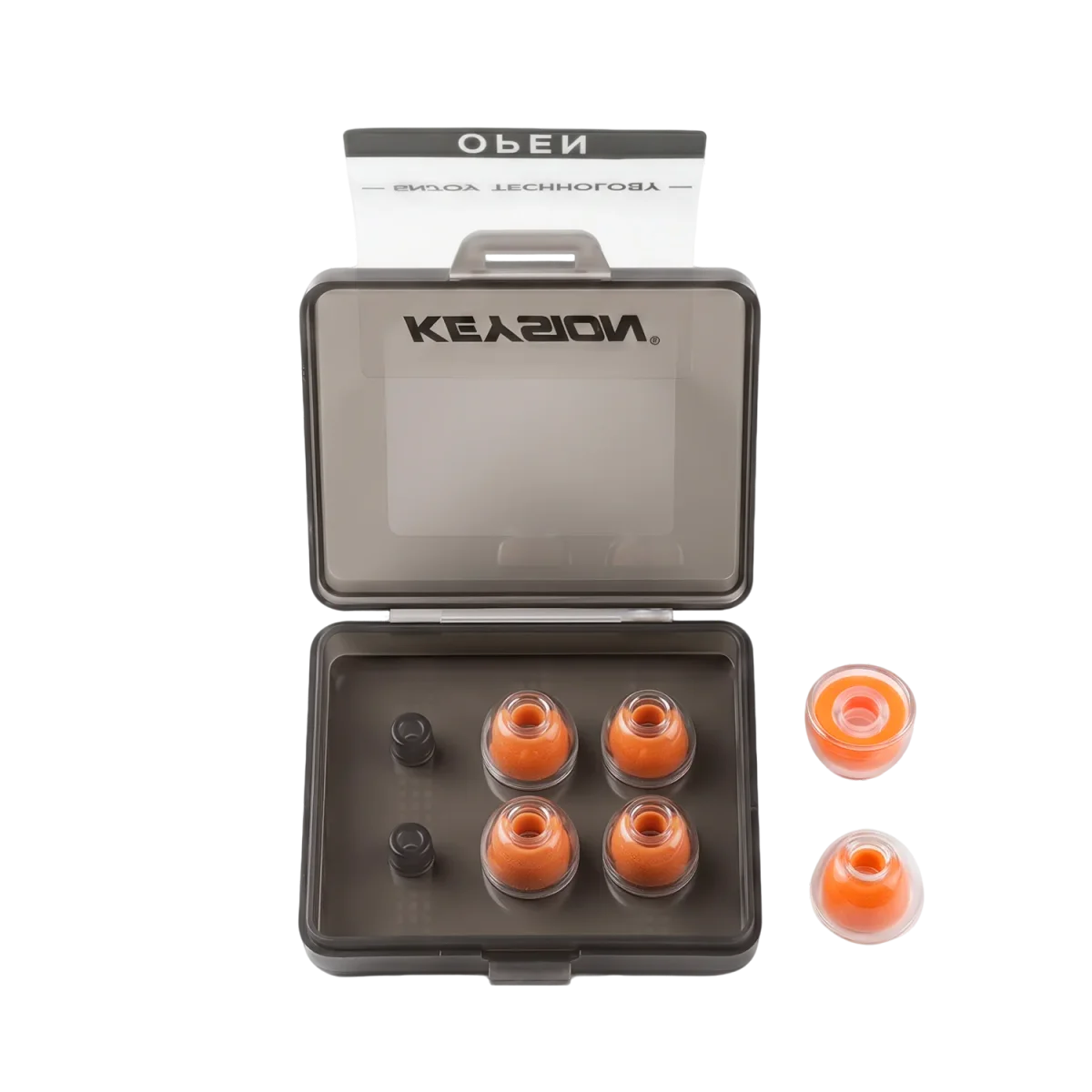
KEYSION's 30A liquid silicone memory foam tips work differently: 30A hardness, slow rebound, so a squeezed tip expands back to the canal shape with a larger contact area than hard silicone. The upside is a seal without deep insertion and less negative pressure. The trade-off is that foam absorbs oil and sweat, so plan on replacing them every two to three months. Sizes come in L, M and S.
06 What can go wrong when you seal a vent?
A diaphragm under constant bias has its excursion limited, distortion rises at high volume and long-term life suffers. Blocking the ear-canal vent lets pressure build, so swallowing or yawning pushes on the eardrum. Condensation cannot drain and tends to collect in the nozzle during humid months.
There is also a paperwork problem. Most brands treat opening the shell or sealing vents as out-of-warranty work. If the tuning really bothers you, ask the service desk before reaching for tape.
07 When to change a cable, and when to leave the vent alone
Vents are acoustics; cables are connections. Fitting a KSHF-YCX OTG cable or a KSHF-AUX analog cable changes impedance matching and contact resistance. It does not make a vent work better or worse.
Do this: thin bass, try tips for seal; weak isolation, try deeper insertion; rattle in the shell, press the housing lightly to see whether it is assembly or airflow. Do not do this: seal vents with tape, glue or putty. A change you hear for a few months can leave permanent damage.
For the background on fit and seal, see IEM fit, seal and sound, noise cancelling versus isolation, how tip material changes sound, and in-ear versus over-ear.
About the author
Written by the KEYSION audio content team. We have taken apart more than a dozen dynamic and balanced-armature in-ears, logged static ear-canal pressure before and after sealing vents with a fine probe and a manometer, and compared four tip types on the same pair. The 5-15 Hz and 1-3 dB figures come from those sessions and describe magnitudes, not a standard; chambers and drivers vary widely, so do not read them as absolute values. Warranty treatment of vent modification follows each brand's official policy.
FAQ
Will blocking the vents on an IEM give me more bass?
Usually not. On a closed-back dynamic driver, sealing the vent lowers rear-chamber compliance and raises resonance, so sub-bass gets shallower and the sound turns congested. The only real gain happens when the tip was leaking and you sealed the leak.
Can tape or glue over the vents damage the earphones?
Yes. A diaphragm kept under bias loses excursion, distorting more at high volume and aging faster. Blocking the pressure vent also traps condensation. Most brands treat shell disassembly and vent sealing as out of warranty.
Why do my ears feel stuffy after the vent is blocked?
That is pressure. With a tip sealing the canal, swallowing and walking change the pressure, and the vent is what bleeds off the excess. Once it is blocked, the pressure pushes on the eardrum.
Is poor isolation caused by the vent or the ear tips?
Start with the tips. A vent usually costs 1-3 dB of passive isolation, while the right tip size can recover 6-10 dB. Leave ANC microphone ports alone; they are not tuning vents.
Do memory foam tips really add bass?
Often, if the problem was a poor seal. 30A slow-rebound foam follows an oval canal with more contact area than stiff silicone, so less low end escapes. It absorbs oil and sweat, so replace it every two to three months.
Related products
Related articles