How Much Power Do Your Headphones Really Need? Impedance and Sensitivity, Calculated
- The two numbers that decide power needs: sensitivity and impedance
- How to work out the power you need: one formula, one table
- What a dongle's 100-600mW can actually drive
- Voltage vs current: why "lots of power" is a sloppy way to say it
- Does enough power end the story?
- FAQ
- How much power do my headphones need?
- Why are high-impedance headphones hard to drive?
- What's the difference between dB/mW and dB/V sensitivity?
- Can a dongle drive 300Ω over-ears?
- Is turning the volume up enough?
- About the author
Headphones that were driven straight from a phone often sound "cleaner" rather than "louder" when you switch to a separate DAC/amp — the headphones that genuinely need lots of power to get loud are rarer than people assume. Power requirements come down to three numbers: sensitivity (dB/mW or dB/V), impedance (Ω), and the loudness you want. Bottom line first: for the vast majority of IEMs, a 100-200mW dongle is already more than enough; the real power hogs are low-sensitivity over-ears (250-600Ω), and those are the ones worth calculating properly.
This article walks through the math and real measurements behind "power" and helps you figure out whether your current gear is enough.
Sensitivity is how loud a headphone gets for a given input. In dB/mW terms, a headphone that reaches 95dB at 1mW is more than twice as "easy to drive" as a 90dB one (every 3dB doubles the power needed). Models rated in dB/V (common on over-ears) tend to look "harder to drive" for high-impedance models once you convert.
Impedance decides whether your source has to deliver voltage or current. A 32Ω low-impedance headphone is mostly a current load; a 300Ω high-impedance one is mostly a voltage-swing load. A lot of dongles' "rated power" is measured at 32Ω — at 300Ω the number drops to a fraction of that. That's not false advertising, it's physics.
| Headphone type | Typical sensitivity | Typical impedance | Real-world need | What it means |
|---|---|---|---|---|
| IEMs | 100-112 dB/mW | 8-32Ω | 0.1-2 mW | Any dongle has plenty to spare; the noise floor matters more |
| Portable over-ears (low impedance) | 98-105 dB/mW | 32-50Ω | 5-20 mW | Most phones get them loud enough; a dongle is more consistent |
| High-impedance over-ears (HD-series style) | 95-100 dB/mW | 250-600Ω | 50-300 mW | Needs high voltage swing; dongles struggle |
The formula is simple: P(mW) = 10^((target SPL − sensitivity dB/mW) / 10). Every +10dB of loudness multiplies the power by 10.
Music isn't a steady tone: pop averages 75-85dB, with peaks another 15-20dB above that. So "loud enough" should be sized to 100-110dB peaks, not average levels.
| Sensitivity (dB/mW) | Impedance (Ω) | Power for 100dB peaks | Power for 110dB peaks | Verdict |
|---|---|---|---|---|
| 112 (sensitive IEM) | 16 | 0.06 mW | 0.63 mW | Dozens of times to spare; stop worrying about power |
| 105 (typical IEM) | 32 | 0.32 mW | 3.2 mW | No strain for any dongle |
| 98 (portable over-ear) | 32 | 1.6 mW | 16 mW | A 361mW-class source is more than enough |
| 96 (high-impedance over-ear) | 300 | 2.5 mW | 25 mW | Power isn't the issue — it's the ~2.7V of swing |
Note the last row: the high-impedance over-ear's "power need" looks small; voltage is the real constraint. Here's the math: V = √(P × R) — 300Ω at 25mW needs about 2.7V RMS, while a 16Ω IEM only needs 0.1V. So whenever you read a dongle's rated power, check which impedance it was measured at.
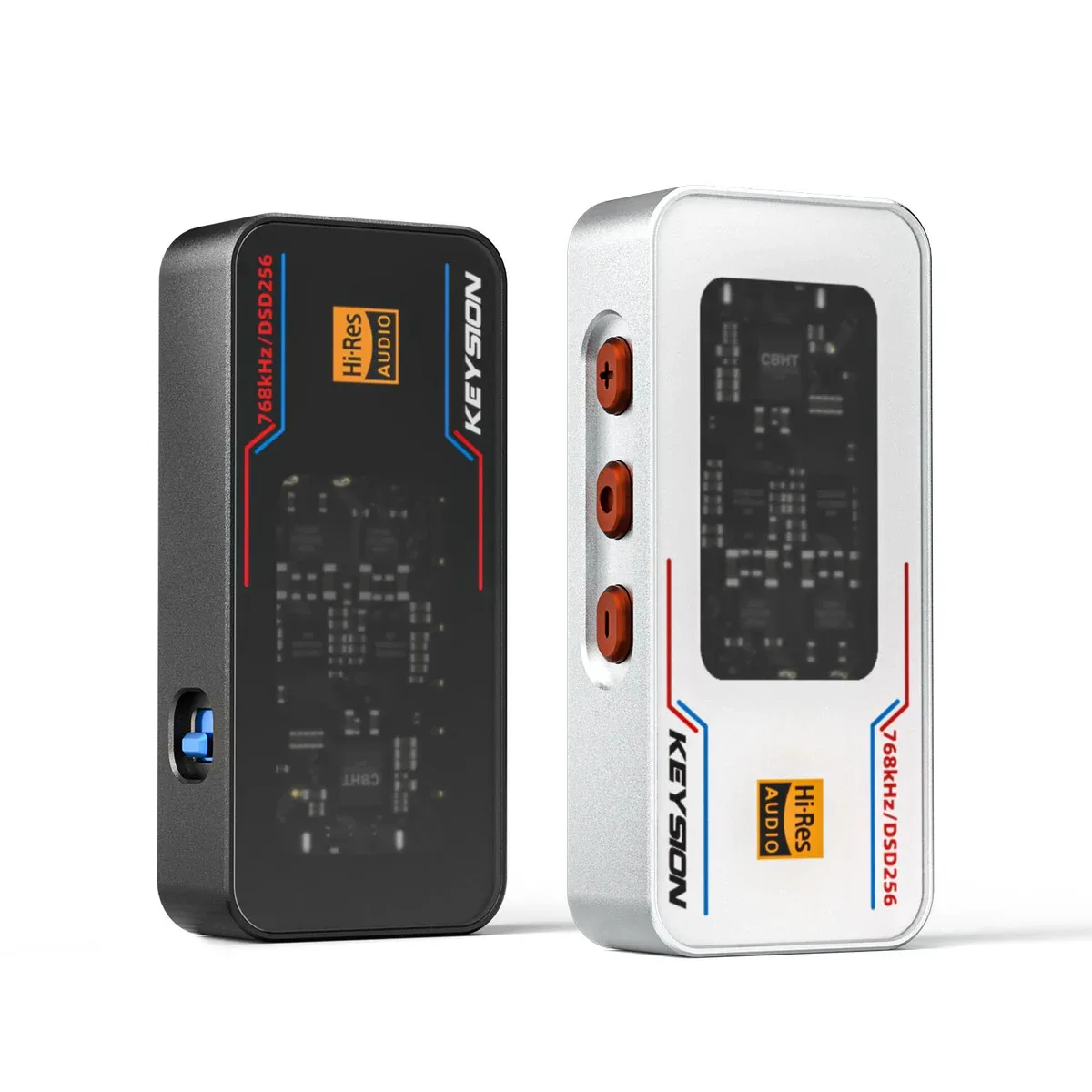
Using KEYSION's three tiers as examples (all measured at 32Ω):
- KEYSION 01: entry level, around 90mW — plenty for sensitive IEMs and portable over-ears;
- KEYSION 02: 361mW@32Ω, drives most 32-150Ω over-ears comfortably;
- KEYSION 02 Pro: 551mW@32Ω — the extra is mostly headroom: cleaner transients, not double the loudness.
Blindly going for more power carries two real risks: a more audible noise floor (especially on sensitive IEMs) and a volume control with only one usable step at low gain. So pick gear by headphone sensitivity first, power second — don't get the order backwards.
"Power" gets thrown around too loosely. Strip it down and there are only two things: voltage swing and current capability. Low-impedance IEMs want current; high-impedance over-ears want voltage. A dongle usually has current to spare at low impedances; its voltage swing at high impedances is the weak spot. A power figure only means something together with the load impedance — 551mW@32Ω and 551mW@300Ω are two completely different capabilities.
No. When new gear "sounds better," it's usually three things rather than power: low output impedance (good damping match), high signal-to-noise ratio (low noise floor), and fine volume steps (matching sensitivity). In blind tests, most people can't tell two devices apart when both have enough power for the same headphone — but they can hear the noise floor. So power is just the entry ticket; don't bet the whole budget on wattage.
Check sensitivity (dB/mW) and impedance, then plug 100-110dB peaks into P = 10^((target SPL − sensitivity)/10). IEMs usually need <2mW, portable over-ears <20mW, and high-impedance over-ears 50-300mW plus the voltage swing to match.
High impedance (250Ω+) needs high voltage swing, and a dongle's power rating measured into a low load doesn't carry over. For the same 100dB, 300Ω needs about 2.7V RMS — many dongles can't reach it, so they sound "soft."
dB/mW is sound pressure per milliwatt of power; dB/V is sound pressure per volt. High-impedance headphones often look better on paper in dB/V, but to convert that into real drive requirements you have to factor in impedance, or the numbers will mislead you.
Depends on the output. A device rated 551mW@32Ω may only deliver 30-50mW into 300Ω, and whether that's enough comes down to headphone sensitivity. For mid-to-high-sensitivity over-ears above 96dB/mW, most dongles get them to a usable-if-not-ideal level.
No. When power runs short, cranking the volume hits clipping first — the sound gets hard and harsh instead of cleanly louder. That's also why "phone-direct into high-impedance over-ears" is often described as "loud but unpleasant."
This article was compiled from measurements by the KEYSION Audio Lab, using the power calculation and loudness conventions common in the industry. Models measured: KEYSION 01 / 02 / 02 Pro. Related reading: How to read headphone specs, Which portable DAC to choose, KEYSION 02 Pro tested.
FAQ
How much power do my headphones need?
Check sensitivity (dB/mW) and impedance, then plug 100-110dB peaks into P = 10^((target SPL − sensitivity)/10). IEMs usually need <2mW, portable over-ears <20mW, and high-impedance over-ears 50-300mW plus the voltage swing to match.
Why are high-impedance headphones hard to drive?
High impedance (250Ω+) needs high voltage swing, and a dongle's power rating measured into a low load doesn't carry over. For the same 100dB, 300Ω needs about 2.7V RMS — many dongles can't reach it, so they sound soft.
What's the difference between dB/mW and dB/V sensitivity?
dB/mW is sound pressure per milliwatt of power; dB/V is sound pressure per volt. High-impedance headphones often look better on paper in dB/V, but to convert that into real drive requirements you have to factor in impedance, or the numbers will mislead you.
Can a dongle drive 300Ω over-ear headphones?
Depends on the output. A device rated 551mW@32Ω may only deliver 30-50mW into 300Ω, and whether that's enough comes down to headphone sensitivity. For mid-to-high-sensitivity over-ears above 96dB/mW, most dongles get them to a usable-if-not-ideal level.
Is turning the volume up enough?
No. When power runs short, cranking the volume hits clipping first — the sound gets hard and harsh instead of cleanly louder.