
Why Does the Same IEM Sound Different on Another Device? Output Impedance and Damping, Explained
- What Is Output Impedance, and Why Does It Change How the Same IEM Sounds?
- The 1/8 Rule: How Low Should Output Impedance Go?
- How Much Does High Output Impedance Shift the Response? The Numbers
- Why Are Multi-Driver Balanced-Armature IEMs the Most Sensitive?
- Damping: The Other Half of What Output Impedance Affects
- How Do I Check Whether My Device's Output Impedance Is Low?
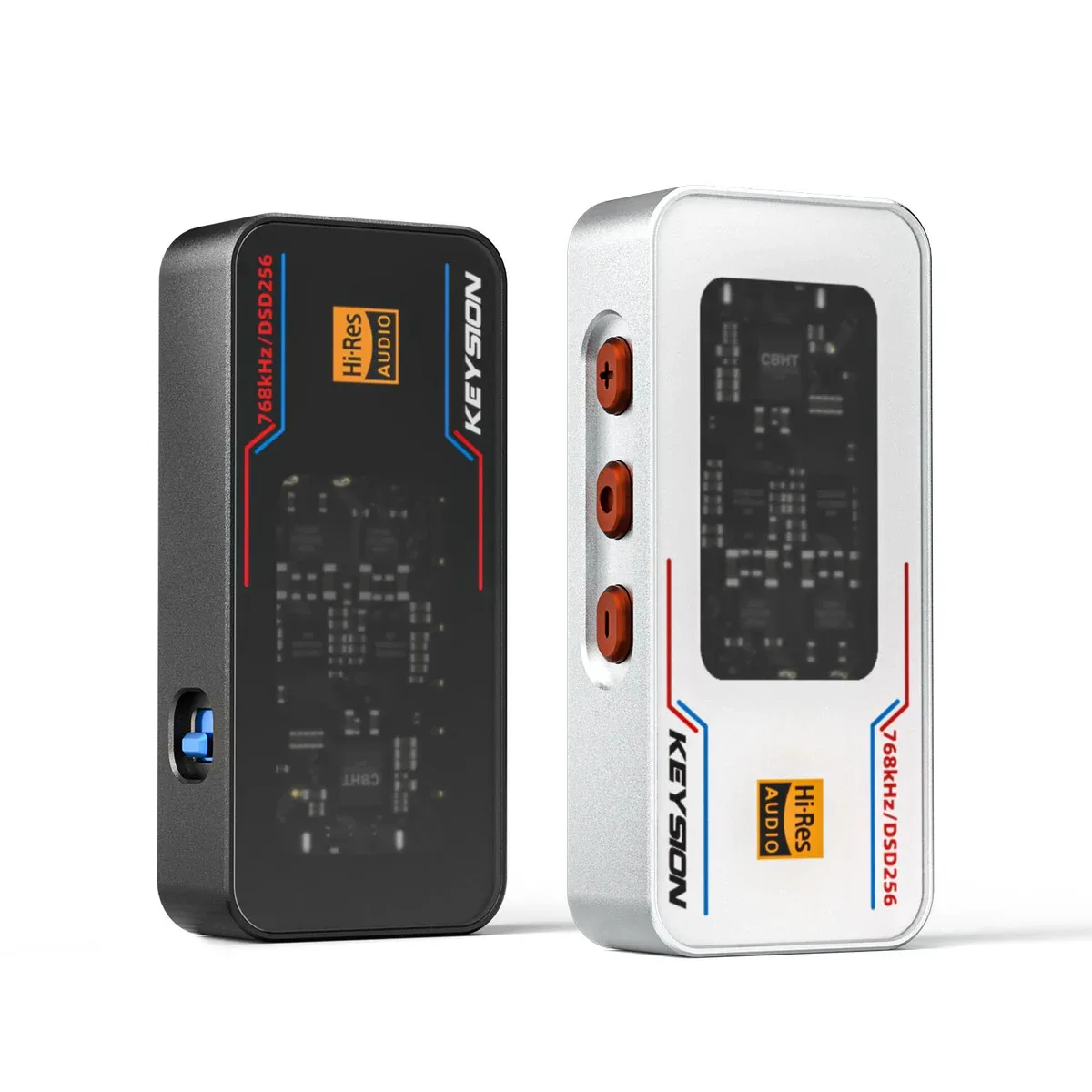
- KEYSION 01 / 02 / 02 Pro, Measured: Output Impedance in Practice
- Conclusion: When Should You Care About Output Impedance?
The same pair of IEMs sounds one way out of a phone and another out of a laptop, and plenty of people put it down to "different device tuning." The physical cause is usually output impedance: the internal resistance at the amplifier's output forms a voltage divider with the IEM's impedance and reshapes the frequency response. Bottom line first: output impedance should sit well below the IEM's impedance, with 1/8 as the common target. When it doesn't, low-impedance, high-sensitivity IEMs tend to sound noticeably "thinner and brighter," and multi-driver balanced-armature models suffer the most. Let's walk through the numbers and some real measurements.
An amplifier is not an ideal voltage source — there is an equivalent internal resistance at its output, and that is the output impedance. When you plug in headphones, the headphone impedance and the output impedance form a series voltage divider, so the headphone only receives part of the available voltage. The catch: an IEM's impedance is not constant. It varies with frequency — a dynamic driver rises in impedance around the low-frequency resonance peak, while balanced-armature drivers and crossover networks make the curve wobble even more.
As the output impedance approaches the IEM's impedance, the division ratio changes from band to band and the frequency response gets "colored." When an IEM's impedance is high in the bass region, it loses more low end, which typically comes across as "thinner bass, more forward vocals, brighter treble." This is not imagination — it is a measurable physical effect.
A long-standing rule of thumb in the industry: output impedance should not exceed 1/8 of the IEM's impedance. For a 32Ω IEM, aim for ≤4Ω; for a 16Ω IEM, ≤2Ω. The reasoning: once the ratio reaches 8, the frequency-response shift caused by output impedance mostly stays within 1dB, which most listeners cannot reliably tell apart.
That said, the 1/8 rule is an engineering heuristic, not a hard standard. Modern dongle DACs commonly measure below 1Ω, far beyond the requirement. Older PC sound cards and some Bluetooth receivers, though, can sit at 10-30Ω — into a 16Ω IEM, the frequency response gets visibly reshaped.
| IEM impedance | Output impedance | Ratio | Low-frequency shift (estimated) | What it means |
|---|---|---|---|---|
| 16Ω | 8Ω | 2:1 | -4 to -6dB | Bass collapses noticeably, sound turns "thin" |
| 16Ω | 2Ω | 8:1 | about -1dB | Most people can't tell; right at the threshold |
| 32Ω | 4Ω | 8:1 | about -1dB | Boundary case; BA models may still show it |
| 32Ω | 1Ω | 32:1 | under 0.5dB | Near-ideal; response essentially unaffected |
| 300Ω | 10Ω | 30:1 | negligible | High-impedance headphones barely care |
These are typical values; the actual shift depends on the shape of the IEM's impedance curve. The takeaway is simple: low-impedance, high-sensitivity IEMs are the worst case for high-output-impedance sources, while high-impedance headphones are nearly immune.
Balanced-armature drivers have naturally uneven impedance curves, and once a crossover network is added, total impedance can differ by several times across bands. With a slightly higher output impedance, those peaks and dips get amplified and the balance between vocals and treble shifts. That is the physical root of the saying that "BA IEMs are picky about sources" — no mysticism, just an impedance-matching problem.
Hybrid IEMs (dynamic + BA) are affected too, though usually less than pure-BA models. If the same pair of IEMs sounds very different across devices, suspect output impedance first, and only then blame cables or your own imagination.
The damping factor equals the IEM's impedance divided by the output impedance, and it measures how firmly the amplifier controls driver movement. As output impedance rises, the damping factor drops, a dynamic driver's low-frequency motion becomes harder to stop quickly, and bass tends to sound loose and muddy — drum hits decay slower, bass lines lose definition, and plenty of people blame the cable first when output impedance is the real cause. High-impedance headphones have naturally high damping, so they are fine; low-impedance dynamics paired with a high-output-impedance source often lose bass texture before any obvious response shift appears. Then again, in most pop and rock material, most listeners can't tell the difference — no need to obsess over it.
Spec sheets often skip output impedance — many manufacturers only list power output. Three workarounds:
- Check the official spec sheet; if "Output Impedance" is listed, trust the number.
- Infer from power: a source that quotes high power into a 32Ω load usually has low output impedance.
- A/B test directly: plug the same IEM into a phone and an old sound card; if the bass changes clearly, the latter's output impedance is probably on the high side.
Take KEYSION's three portable DAC/amps: the 01 is a single-ended 3.5mm dongle DAC, while the 02 and 02 Pro pair a 3.5mm single-ended output with a 4.4mm balanced one. All three are rated for 16-600Ω loads, and measured output impedance lands around 1Ω in each case — comfortably inside the 1/8 rule, so with IEMs above 16Ω you won't hear a meaningful response shift.
Where the three differ is noise and power: the 01 offers 130dB SNR on single-ended; the 02 offers 125dB single-ended / 130dB balanced, 361mW@32Ω; the 02 Pro offers 130dB single-ended / 135dB balanced, 551mW@32Ω. In other words, with these three, whatever you hear changing between sources mostly comes from noise floor and headroom, not from a reshaped frequency response. For a deeper look at specs, see Understanding Dongle DAC Specs and How Much Power Do Headphones Really Need?.
If you use low-impedance, high-sensitivity IEMs — especially multi-BA models — treat output impedance as a hard spec when choosing a source: prefer devices rated ≤1Ω, such as KEYSION 02 Pro or KEYSION 02. High-impedance headphone owners can mostly stop worrying. The one-line test: IEM impedance ÷ output impedance ≥ 8. If you can't reach it, change sources.
This article was written by an audio engineer at the KEYSION lab. Data comes from official specs and public measurements; individual units vary, and the listening impressions are subjective — take them as reference only.
FAQ
How low is low output impedance, and what counts as acceptable?
By the 1/8 rule of thumb, output impedance should not exceed 1/8 of the IEM's impedance. For a 32Ω IEM that means ≤4Ω, and for a 16Ω IEM, ≤2Ω. Most modern dongle DACs go below 1Ω, which is an excellent level.
Why does my balanced-armature IEM sound so different after I switch players?
BA drivers have uneven impedance curves, and once a crossover is added, total impedance can differ by several times across bands. With a slightly higher output impedance, those peaks and dips get amplified and the vocal-to-treble balance shifts. Check the source's output impedance before blaming the cable.
Can high output impedance damage my headphones?
No. High output impedance only changes the frequency response and damping; it poses no electrical damage risk. What deserves caution is very high power from a near-zero output impedance into low-impedance IEMs, which can cause overload — though that is rare with dongle DACs and portable players.
Is output impedance the same on balanced and single-ended outputs?
On most devices they are close, but the balanced output usually offers more voltage swing and higher SNR. The KEYSION 02 Pro, for example, measures 130dB SNR single-ended and 135dB balanced, with output impedance around 1Ω in both cases.
Does the 1/8 rule apply to all headphones?
It mainly applies to low-impedance, high-sensitivity IEMs, especially multi-BA models. High-impedance headphones (300Ω class) are nearly immune: a 10Ω output into a 300Ω headphone has a negligible effect.