Powered or Passive Desktop Speakers? Amp, Inputs and Source Order for a First Setup, and Where KSHF-02 Pro Fits

- What actually separates powered and passive speakers?
- Why powered speakers make more sense at a desk
- The extra amplifier in a passive system: what to calculate
- How to read sensitivity and impedance
- Inputs: 3.5 mm, RCA, optical and Bluetooth
- Can a portable DAC like KSHF-02 Pro feed desktop speakers?
- Where the budget should go first
- Who should choose which
- A four-step start
This is for someone building a first 2.0 speaker setup on a desk. If your desk is under 1.2 m wide, you want fewer cables, and most of your listening is streaming or video, start with powered speakers. If you already own an amp, or plan to change speakers and amp in separate steps, go passive. Use the source you already have, whether that is a computer, an audio interface or a DAC. You do not need a second front end just because speakers entered the room.
What actually separates powered and passive speakers?
A powered speaker has its amplifier inside the cabinet. Plug in power, feed it a line-level signal, and it plays. A passive speaker has drivers and a crossover only; it needs an external amplifier, and that amplifier takes the signal from the source. The difference is not "which one sounds better." It is who takes responsibility for matching the amp to the drivers. With powered speakers, the manufacturer does it. With passive speakers, you do.
That also gives you two different ownership paths. Powered speakers are a finished package. Passive speakers are a set of parts you can swap one at a time.
Why powered speakers make more sense at a desk
Near-field listening usually happens at 0.6 to 1 m. You do not need much sound pressure. Most 3 to 5 inch powered desktop speakers deliver 20 to 50 W RMS per channel, which is enough for this distance. They also take two fewer speaker cables and one fewer power outlet. When desk space is tight, that practical difference matters more than a few dB on a spec sheet.
The trade-off is a short upgrade path. If the amp dies, or you want a larger cabinet, you usually replace the pair. Some models run warm when pushed for hours in summer, especially with the cabinet close to a wall.
The extra amplifier in a passive system: what to calculate
Three numbers matter: impedance, sensitivity and the amp's continuous output. Take an 8 Ω speaker rated 86 dB/2.83 V/1 m. To reach 85 dB at 1 m, it needs about 0.8 W. Leave 10 dB of headroom for peaks, and 15 to 30 W RMS per channel covers it. A 90 dB speaker needs only about 0.3 W for the same level.
The hard case is low sensitivity plus low impedance. A 4 Ω, 84 dB speaker can pull 60 W or more on peaks. Look at the amp's 4 Ω rating and its power supply reserve, not the "200 W peak" badge. A desk setup rarely needs sustained high power, but transients and heat still need margin.
| Item | Powered speakers | Passive speakers | What it means for you |
|---|---|---|---|
| Amplifier | Built in, matched by the maker | External, chosen by you | Powered is simpler; passive is swappable |
| Cabling | Power plus signal | Power, signal and speaker cable | Passive adds a pair of speaker cables |
| Upgrades | Usually replace the pair | Cabinet and amp can change separately | Passive suits long-term tinkering |
| Power matching | Handled by the maker | You calculate impedance and sensitivity | A wrong amp can underdrive or waste power |
| Placement | Limited by the internal amp | Cabinets can be slimmer | Little difference at near field |
| Repair | Amp failure means servicing the whole box | Amp can be replaced alone | Passive is more flexible to repair |
How to read sensitivity and impedance
Sensitivity is the sound pressure at 1 m with a 2.83 V input, stated in dB. Every 3 dB increase halves the power needed. Every 3 dB decrease doubles it. The gap from 86 dB to 89 dB looks small, but it doubles the amplifier power requirement.
Impedance sets the current. Going from 8 Ω to 4 Ω doubles current for the same power, which puts more strain on the amp's supply and cooling. A nominal 4 Ω speaker can dip to 3 Ω at some frequencies. Check the 4 Ω rating in the amp manual, not just the 8 Ω number.
Inputs: 3.5 mm, RCA, optical and Bluetooth
3.5 mm and RCA both carry unbalanced line level, which is fine over 1 to 2 m on a desk. RCA holds contact more firmly; 3.5 mm saves space. Optical breaks a ground loop, so it can remove some hum when a TV or computer shares power with the audio gear. The common limit is 48 kHz/16-bit, which is enough for music.
Bluetooth is for convenience. SBC and AAC often run 100 to 300 ms of latency, so video can drift out of sync. aptX Low Latency or LC3 can cut that to tens of milliseconds, but both ends need to support it. For a fixed desk, use a cable first.
Can a portable DAC like KSHF-02 Pro feed desktop speakers?
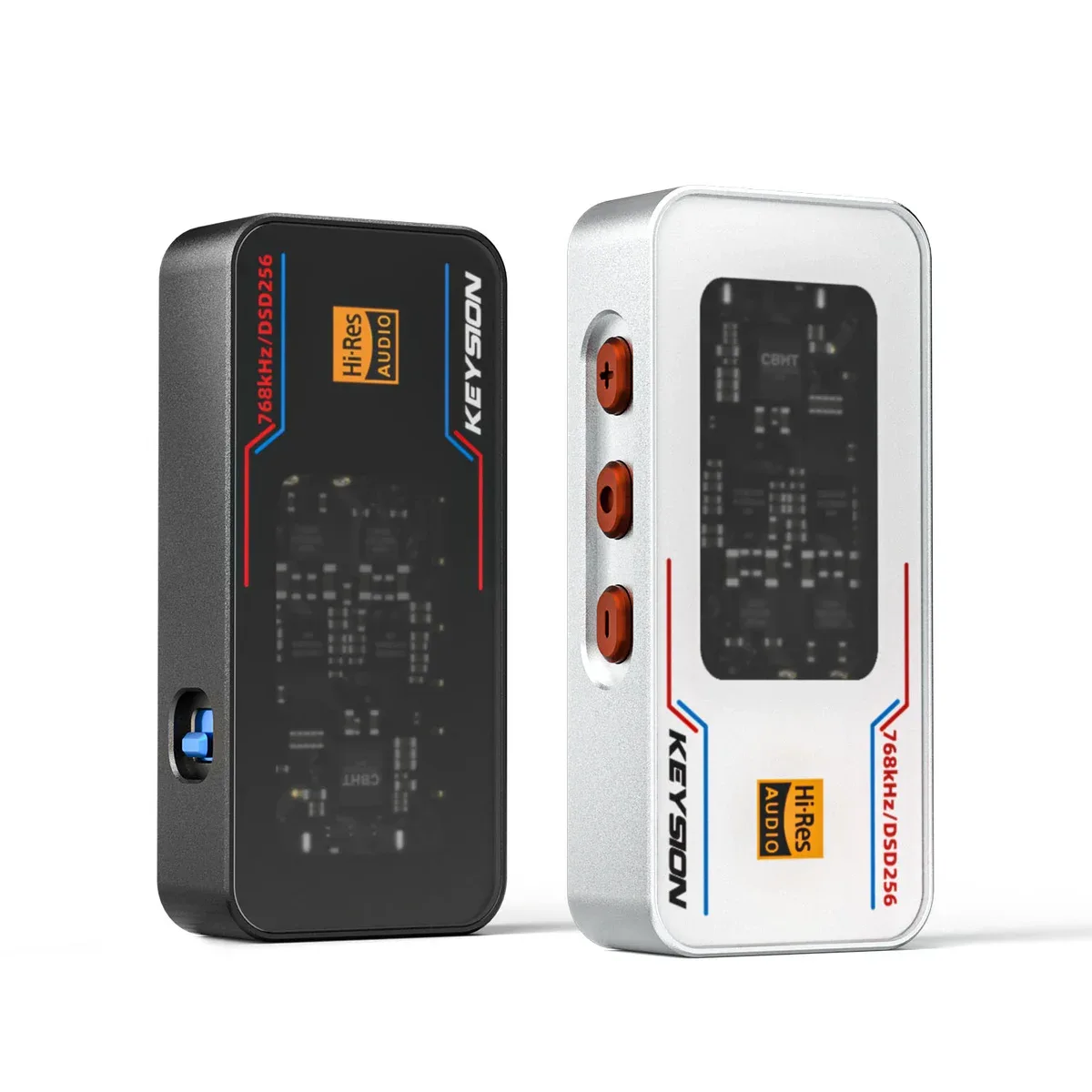
Be clear about the ports. KSHF-02 Pro has 3.5 mm single-ended and 4.4 mm balanced headphone outputs. It is a headphone DAC and amp, and its 551 mW at 32 Ω is meant for headphones. It has no dedicated line output and no speaker output.
To feed powered speakers you would have to run the 3.5 mm headphone jack into a dual RCA cable. That sends a headphone output into the speaker's amplifier, so you adjust volume in two places and stack noise and distortion. It works, but it is not a good long-term arrangement. Driving passive speakers is out of the question; the headphone jack cannot handle a 4 Ω or 8 Ω speaker load.
A cleaner setup: give the speakers a desktop DAC, audio interface or preamp with a line out. Keep KSHF-02 Pro in the headphone system. Two separate chains mean one less adapter and one less failure point. Portable amps such as H-Turbo S2 are also built around headphone output, so do not treat the words "DAC and amp" as proof that a device can drive speakers.
If you are still assembling a first desktop headphone system, read how to build a first desktop HiFi setup first. Sort out the headphone chain, then decide whether speakers need their own front end.
Where the budget should go first
Order by marginal return: speakers first, amp matching second, placement third, cables and power last. At a desk, cabinet position and wall reflections change the sound more than another cable usually does.
Start by placing the two speakers about 60 degrees apart from the listening position, 10 to 20 cm from the rear wall, with the woofer out of direct contact with the wall. Do not rush into power treatment. If a switching supply, a desktop DAC and powered speakers share one strip and you hear a steady hum, check the ground loop before buying a new supply. The linear power supply article separates ripple, grounding and audible limits.
Who should choose which
Choose powered if your desk is 1 to 1.5 m wide, you want one purchase, you mostly stream music and watch video, and you have no interest in swapping amps.
Choose passive if you already own an amp, you plan to upgrade in stages, you want to keep the amp when you change speakers, or you need slimmer cabinets placed closer to a wall.
Neither suits someone hoping a cable will fix weak bass, or someone pairing a 4 Ω, low-sensitivity speaker with an entry amp rated only at 8 Ω.
A four-step start
- Measure the desk and the listening distance, then set the maximum cabinet width.
- Choose powered or passive, then estimate amp power from sensitivity and impedance.
- Pick the input: 3.5 mm or RCA first, optical if you need to break a ground loop.
- Place the speakers, listen for a week, then revisit cables and power.
About the author: KEYSION Audio Editorial. We test portable DACs, headphone amps and cables in near-field desktop setups over long periods. The power figures here are conservative estimates based on sensitivity and distance; room reflections and cabinet placement will change the result. Product links explain ports and positioning, not a requirement to buy. Sensitivity and SPL conversions follow the IEC 60268-5 2.83 V/1 m definition, with power estimated into an ideal resistive load. Last updated: 2026-11-05..
FAQ
Do powered speakers need a separate amplifier?
No. The amplifier is already inside the cabinet. You only supply power and a line-level signal. The catch is that the amp and drivers are tied together, so a failure usually means servicing the whole speaker and an upgrade means replacing the pair.
Do passive speakers require an expensive amplifier?
Not necessarily. At about 1 m on a desk, an 8 Ω speaker rated 88 dB or higher can be covered by 20 to 30 W RMS per channel. Check the 4 Ω rating and the power supply reserve rather than trusting a peak wattage number.
Can KSHF-02 Pro drive passive speakers directly?
No. It is a headphone DAC and amp with 3.5 mm and 4.4 mm headphone outputs. It has no speaker output and cannot drive a 4 Ω or 8 Ω speaker load. Passive speakers need a power amplifier.
Is 3.5 mm or RCA better for desktop speakers?
Both are unbalanced line level, and over 1 to 2 m the difference is small. RCA holds contact better for a fixed setup; 3.5 mm saves space for temporary wiring. If you hear hum, check grounding before changing plugs.
Does Bluetooth hurt sound quality on desktop speakers?
The bigger issues are latency and stability, not volume. SBC and AAC are fine for music in a quiet room, but video may lose lip sync. For a fixed desk, a cable is still the safer choice.
Related products
Related articles