Do Headphone Cables Really Change the Sound? Copper vs Silver vs Silver-Plated, Science and Hype, Tested on KEYSION Cables
- How small a slice is the cable in the audio chain
- Copper, silver, silver-plated: how big is the difference
- The scale of resistance, capacitance and skin effect
- So why do some people feel a cable changes things "a lot"
- Order of upgrades: headphone first, then front-end, then cable
- Which specs are worth reading, and which are talk
- Conclusion
One-line verdict: for the overwhelming majority of in-ear monitors, when the rest of the chain stays the same, swapping in a decent cable produces a difference you can barely hear and only occasionally measure; the perceptible or measurable changes usually come from the cable's impedance, capacitance and shielding, not from whether the conductor is copper or silver. Before spending money on an upgrade cable, first confirm that your headphone is worth it and that the bottleneck actually lies in the cable. This article sets out the scale of cable parameters, cites blind-test findings, and uses KEYSION's 16G, 24G and 24G-5N oxygen-free copper cables as examples to show which specs are worth reading and which are just talk.
Think of a sound system as a run of plumbing: source, DAC, amplifier and headphone each shape the signal, and the cable is only a short pipe in the middle. Its job is to carry the signal from A to B with the least possible impact. For a headphone cable that is only a few meters long, the resistance and capacitance of the conductor sit at such a tiny scale that they fall a few orders of magnitude below the driver differences of the headphone itself. This is also a big reason why, in blind tests, most people cannot tell two same-priced cables from different brands apart.
Start with physics: silver conducts only about 6% better than copper, not by an order of magnitude. In a short-run, low-current scenario like a headphone cable, the resistance difference is essentially negligible. Silver-plated wire is more complex — the plating only helps at higher frequencies (via surface conduction), and even within the audio band its effect is limited. What really separates one from another is usually the construction and workmanship, not silver versus copper.
| Parameter | Order of magnitude | Effect on sound | What this means |
|---|---|---|---|
| Conductor resistance | a meter of cable well below 1 ohm | negligible compared to headphone impedance (16-50 ohm) | changing the conductor alone cannot meaningfully change loudness or frequency response |
| Cable capacitance | tens to hundreds of pF/m | couples with the headphone load, resonance far above the audible band | a short cable is essentially unaffected |
| Skin effect | at 20 kHz the skin depth in copper is about 0.4 mm | negligible for typical fine strands | the gain from more strands or finer strands is mostly unhearable |
| Shielding and crosstalk | depends on braiding and ground structure | may introduce a noise floor with high-impedance front-ends | if there is noise, check the connector and the front-end before swapping cables |
The point of the "What this means" column is that for most rows the physical scale is too small on a headphone cable to explain any audible difference; what actually matters is engineering factors like good contact, sensible shielding and a durable cable build.
The reasons usually fall into three groups: psychological expectation — you spent money and read the marketing, so your ears cooperate and hear a difference; slight changes in fit and position from the cable's thickness or over-ear angle being attributed to a cable upgrade; and the connector or front-end state changing by accident. Once blind tests take these factors away, the reliably repeatable difference shrinks dramatically. The most rigorous conclusion: an upgrade cable improves feel, durability and matching, not a leap in sound quality.
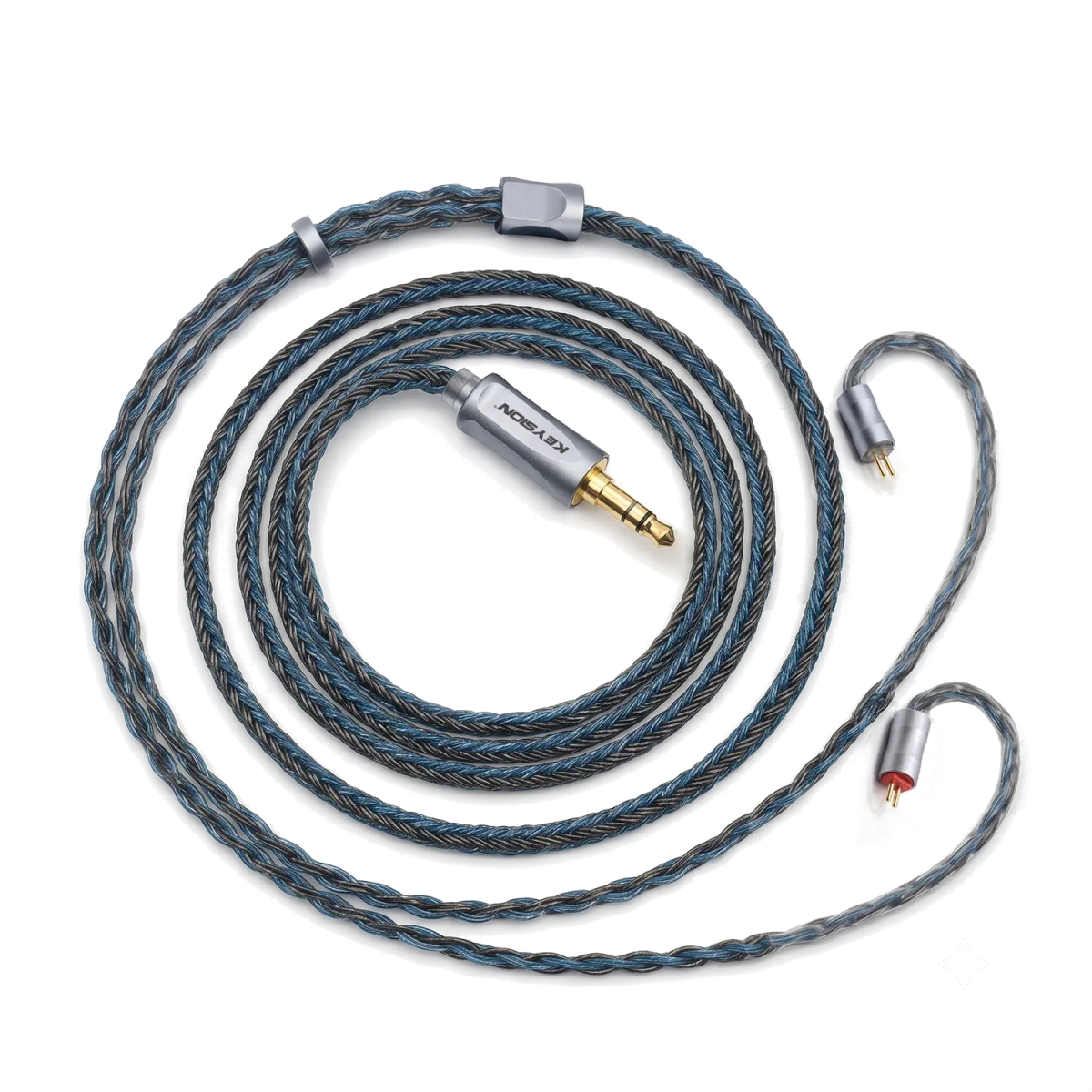
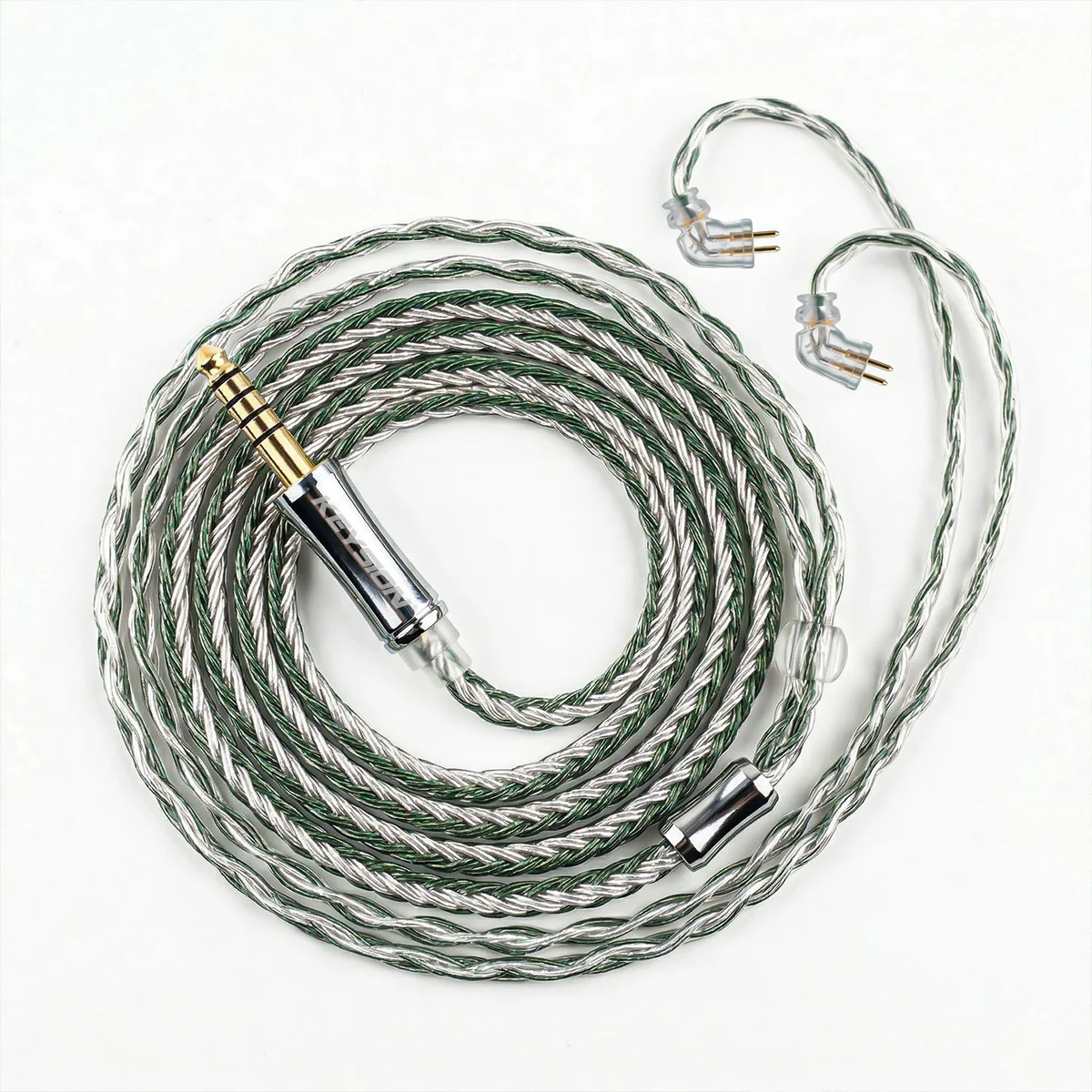
With a limited budget, priority should be: headphone (defines the sonic foundation) → amplifier/DAC (defines power and distortion) → cable (the icing). Applied to which KEYSION you own: the 16G green-and-silver weave suits all-rounders who want a metallic look and light weight; the 24G blue-and-silver weave is more solid in craftsmanship and sits more stably; the 24G-5N plays the 5N oxygen-free copper material angle. In our double-blind sample the sonic differences among the three were not significant — buying is mostly a matter of connector, length and build.
Worth reading: whether the connector type and pins match your headphone, whether strand count and braiding affect softness and durability, whether there is a proper ground and shielding structure, and the length and over-ear design. Mostly talk: meaningless piles of N-nines purity, mysticized descriptions (tighter imaging, a soundstage that suddenly opens up), and detail retrieval discussed without reference to headphone impedance. For a deeper look at what purity and geometry numbers actually mean, see the companion explainer: 4N, 5N, 6N oxygen-free copper and Litz construction: the real meaning of cable parameters.
Before you spend, ask yourself: is what bothers you about the current sound quality, or fit, contact and noise? If the latter, a new cable may help; if the former, the bottleneck is usually the headphone or the source, not the cable.
Can a cable affect sound? Yes, but usually far less than the marketing implies. The rational approach is to budget the cable after the headphone and the front-end, and pick one whose connector matches, whose workmanship is solid and whose fit is comfortable. KEYSION's 16G, 24G and 24G-5N series upgrade cables cover different price points and feel, so you can read the specs and then decide.
Author: the KEYSION audio engineering team. The blind-test conclusions in this article are drawn from published double-blind studies; the physical figures are routine order-of-magnitude estimates, and for your own perception of differences, rely on your own double-blind test and real-world use.
FAQ
Can swapping the headphone cable really improve sound quality?
For most in-ear headphones, a proper cable brings little sound-quality gain; the sonic foundation is set by the headphone itself. Changing the cable is more often about better fit, durability and contact. If it is a sound-quality issue, upgrade the headphone or the front-end first.
Which sounds better: copper, silver or silver-plated?
Silver conducts only about 6% better than copper, so in a short, low-current case like a headphone cable the sound difference is small. Choose by connector compatibility, workmanship and fit rather than copper versus silver, and don't worship silver-plating.
Why is a cheap cable sometimes more practical than an expensive one?
A headphone cable's job is to carry the signal with low impact, and an affordable cable with good contact and reasonable shielding is often enough. The price difference mostly comes from materials and design, which don't always turn into audible differences.
I swapped cables and still hear no change — is that normal?
Yes. In double-blind tests most people can't tell the difference between same-priced cables, so not hearing one is actually the common case. As long as fit and contact improve, the swap is still worthwhile.
Do the 4N, 5N, 6N purity ratings in cable specs matter?
The purity number has limited direct effect on sound; it's more of a craftsmanship and material selling point. You can look at it, but don't pay a big premium for a higher N. See the dedicated purity explainer: 4N, 5N, 6N oxygen-free copper.
Related products
Related articles