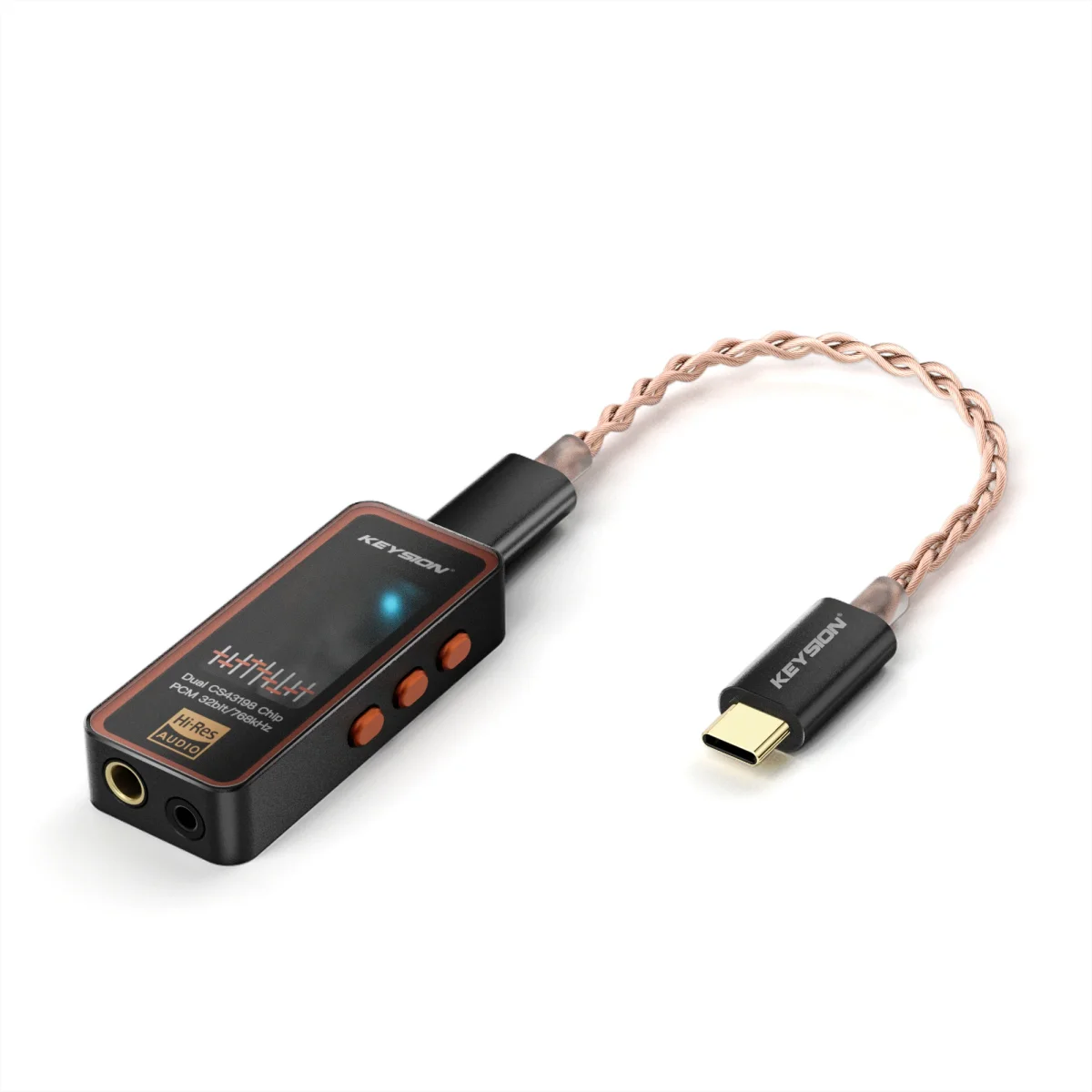
How Loud Is Too Loud? Sound Pressure, WHO Limits and Hearing Protection, Explained With a KEYSION 02 Pro
- What sound-pressure level (dB) actually means
- What volume counts as safe: the numbers from the WHO and occupational health
- A phone volume bar is not a sound meter: how to listen with devices like the KEYSION 02 Pro
- Why bass always seems thin at low volume: loudness compensation
- Common misconceptions: buying better gear does not equal safer
- How to tell you have turned it up too loud: three self-checks
- Conclusion: treat volume as a quantifiable budget
One-sentence takeaway: for most in-ear earbuds, keeping the sound-pressure level at your eardrum at or below 85 dB and listening for no more than 8 hours in a row is a relatively safe usage range. Phone volume bars have no decibel scale, so learn to calibrate with two checks: "can I still talk to someone normally?" and "does it still feel loud when I take the earbuds out?" Above 85dB, every additional 3dB halves the time you can withstand — 88dB is only good for 4 hours, 91dB for just 2. This guide explains the relationship between sound-pressure level and your hearing, and uses a 551mW-output DAC amp like the KEYSION 02 Pro to address a misunderstood point: more output power does not mean you should turn it up; it gives you room to dial it back.
dB is the decibel, a logarithmic ratio of sound-wave pressure relative to some reference value — in short, a relative unit. 0dB SPL is roughly the quietest sound a human ear can hear; a live rock show easily reaches 110dB. The key is not the size of the number but the rule that "every 3dB doubles the sound pressure" — it determines how much more pressure your eardrum actually has to bear. Many people treat 76dB and 79dB as basically the same thing, yet the latter already makes the ear carry nearly twice the pressure.
The World Health Organization (WHO) and occupational-health bodies around the world give strikingly consistent standards: 85dB SPL for 8 continuous hours is the safety ceiling; each additional 3dB halves the allowed duration (industry calls this the 3dB exchange rate, or the 10-decibel rule). This is not conservative wellness advice but a conclusion drawn from large epidemiological studies on noise-induced hearing loss in adults. Brief exposure above 100dB can cause damage within minutes.
| Sound pressure (dB SPL) | Safe listening time | Real-world comparison | What this means |
|---|---|---|---|
| 85 | 8 hours | Slightly noisy street or subway | Upper comfort limit for most daily use; staying right at the line still carries cumulative risk |
| 88 | 4 hours | A crowd talking loudly, busy shopping district | A bit higher and the time budget is cut right in half |
| 91 | 2 hours | Office rush hour, noisy restaurant | A common "medium-loud" is already close to the danger zone |
| 94 | 1 hour | Music-festival outer area, loud bar | Damage starts accumulating within tens of minutes to an hour |
| 100 | 15 minutes | Rock show, electronic dance party | Already "short-term excess"; do not try to recreate it with earphones |
| 110+ | A few seconds | Next to an ambulance or police siren | Even very short exposure can cause discomfort and damage |
The point of the "what this means" column: many scenes you think of as "just ordinary volume" are already past the safety line, and every big step up makes the time budget shrink precariously.
A phone volume bar is not a linear sound meter. The real loudness is set by the volume step, earphone sensitivity, and how well the eartips seal: at the same volume-step position, high-sensitivity earbuds driven directly are far louder than low-sensitivity dynamic over-ears. The KEYSION 02 Pro's 551mW@32Ω is not meant to be pushed to full volume — it gives low-sensitivity headphones headroom so you can reach enough sound pressure at a lower volume step and avoid hitting distortion too early.
There is a boundary that is easy to blur: a safe volume solves "how much sound pressure your ears take"; output power solves "whether the headphones are loud enough and how much distortion there is." The two cannot replace each other. For a detailed calculation of power and impedance, see Do Headphones Really Need That Much Power? Impedance and Sensitivity, Explained in One Go.
Human hearing is non-linear in how it perceives sound pressure — that is the Fletcher-Munson equal-loudness contour. Below roughly 60-70dB, the ear becomes less sensitive to low and high frequencies, and bass drops off the fastest. So when you turn the volume down, you have not "truly" lost the bass; your ear is simply less sensitive to low frequencies. Many portable DAC amps offer loudness compensation or EQ presets to ease this, and the KEYSION 02 Pro, 02 and 01 all bundle multiple EQ groups that can be adjusted in both the app and the web console.
This also explains why some people habitually turn it up to hunt for bass — they are trading sound pressure for perceived bass, and it is the ear that pays. The steadier approach is to keep the volume in the safe zone and add low end with EQ instead of ratcheting the volume all the way up.
Here are a few misconceptions we keep running into during bench tests and after-sales support:
- "More output power means more damage to the ears." Not true. What damages hearing is sound pressure, not output power. More power just lets a high-sensitivity earbud reach the "already loud" point sooner — a reason to be more restrained, not less.
- "With noise cancelling on, I can safely listen loud." ANC lowers ambient noise so you hear clearly at a lower volume — that is an advantage. But if the quiet makes you sneak the volume up, it defeats the purpose.
- "Young ears are tough and can take it." Noise-induced hearing loss is cumulative and irreversible; once past the threshold it does not recover, regardless of age — it is only a matter of sooner or later.
- "Lossless quality is gentler on the ears." Lossless or high sample rates have no relation to hearing damage — see Lossless Formats and Bluetooth Codecs: What FLAC, DSD, LDAC and aptX Actually Change for the principles. Damage depends only on sound pressure and duration.
- Conversation test: Can you still talk normally to the person next to you while music plays? If you cannot hear them, turn it down.
- Habitual-volume test: Set the volume where it feels "comfortable" to you, remove the earbuds, and have a companion speak at a normal level — you should hear them clearly and steadily.
- Fatigue check: If you can listen for more than two hours without getting tired, or even keep turning it up, your hearing is often starting to adapt — that is the sign to stop and rest.
A more precise route is to buy a sound-level meter or use an app's reference decibel reading, but most people never need precision down to a decibel. If you also want to rule out background noise and interference in the playback chain, see the section on source noise in Hissing and Background Noise in Your Earphones: Is the Device Broken? — it overlaps with volume settings.
Hearing damage is not instantly visible like a blurry picture; it is more like savings — however much sound pressure you deposit into your "hearing-damage account" today will not vanish. The 85dB/8-hour line is a crude one, yet plenty of real-life scenes break through it easily. Set yourself a plain rule: keep the volume of a device like the KEYSION 02 Pro, 02 or 01 down at a low level in daily use, listen briefly when loudness is genuinely needed, and leave the rest to EQ.
For eartips matched to your ear canal, see 30A Liquid-Silicone Memory-Foam HiFi Eartips. To understand power headroom, check the specifications of KEYSION 02 Pro, KEYSION 02 or KEYSION 01.
About the author: the KEYSION audio-engineer team. Sound-pressure and hearing standards follow the WHO and occupational-health guidelines; device parameters come from the official KEYSION 02 Pro/02/01 specifications. This article is educational reference only, and individual differences always defer to your own ears and a hearing check.
FAQ
What volume is safe on my phone?
What matters is the level reaching your ears: 85dB for 8 continuous hours is the ceiling. Phone volume bars have no dB scale, so keep everyday playback in the 40%-60% range and drop it whenever it feels loud.
Does each volume step double the hearing damage?
Not every step, but roughly every 3dB doubles sound pressure and halves the safe listening time. Prolonged loud playback accumulates more damage than an occasional spike.
With noise-cancelling on, can I listen louder safely?
ANC lowers ambient noise so you can hear more at a lower volume, which is good. But if the quiet environment makes you sneak the volume up, it cancels out the protection.
Does a powerful DAC like the KEYSION 02 Pro hurt my hearing?
Sound pressure hurts hearing, not raw output power. More power just makes it easier to reach a louder position; if you keep the level in the safe zone, the power itself is harmless.
How can I roughly tell if my volume is safe?
If you can still hold a normal conversation while playing music and hear a friend speaking at a normal level after removing the earbuds, you are loud but not in immediate danger; take breaks on long sessions.
Related products
Related articles